How to Enable or Disable Diagnostic Data Viewer in Windows 11


- 15 steps
- Needs administrator rights
- Group Policy needs Windows 11 Pro, Enterprise or Education
- Includes a restart or sign-out
The Diagnostic Data Viewer in Windows 11 is a built-in app that lets you read the diagnostic logs your computer sends back to Microsoft. Windows collects these system files and app usage records by default to fix bugs and improve security.
Turning on the viewer lets you inspect that telemetry data on your own PC. Windows keeps a local copy of what it collects, and the viewer reads it. Turning the feature off stops this detailed local logging, though basic (required) security data sharing continues to run in the background. This guide covers three ways to change it: the Settings app, the Local Group Policy Editor and the Registry Editor.
Open Settings, select Privacy & security, click Diagnostics & feedback, expand View diagnostic data, and toggle the switch On or Off. The change applies immediately without requiring a restart.
Is the Diagnostic Data Viewer Installed by Default?
The Diagnostic Data Viewer is not pre-installed on Windows 11. You need to download the Diagnostic Data Viewer app from the Microsoft Store before you can review the information your device sends to Microsoft.
Installing the app does not start any collection by itself. It is only the reader. The viewer shows data only while the View diagnostic data setting is turned on, as described in the next section. If you plan to use the app, install it first, then turn the setting on.
Using the Settings App
The Settings app is the quickest way to turn this feature on or off, and it works on every edition of Windows 11, Home included. You go into the privacy options and find the diagnostics controls. There you choose whether your device saves this information so you can view it.
No restart is needed for this method. The change applies as soon as you flip the switch.
- Open the Windows Settings app. The Settings window opens with the System page showing.
- Select Privacy & security on the left. The privacy options appear on the right.
- Click the Diagnostics & feedback tile on the right. You may need to scroll down the page to find it under the Windows permissions area. The diagnostics page opens with its own list of tiles.
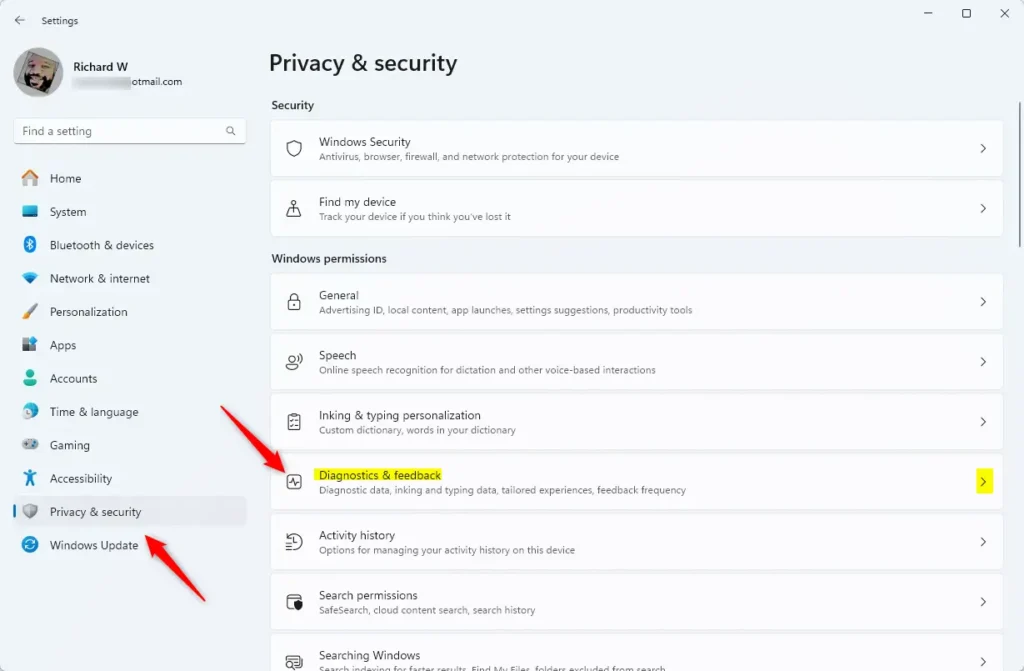
- Select the View diagnostic data tile to expand it. The toggle switch and a short description appear inside the tile.
- Use the toggle switch to turn it On or Off. The label next to the switch changes to match your choice.
When the switch is On, Windows keeps a limited amount of recent diagnostic data on the PC for the viewer to read. The tile then shows a button to open the Diagnostic Data Viewer app. Turning the switch Off stops that storage, and Windows clears the data it was holding for the viewer. If the switch is greyed out, or Settings says some settings are managed by your organization, a policy is controlling it. See the Group Policy section below.
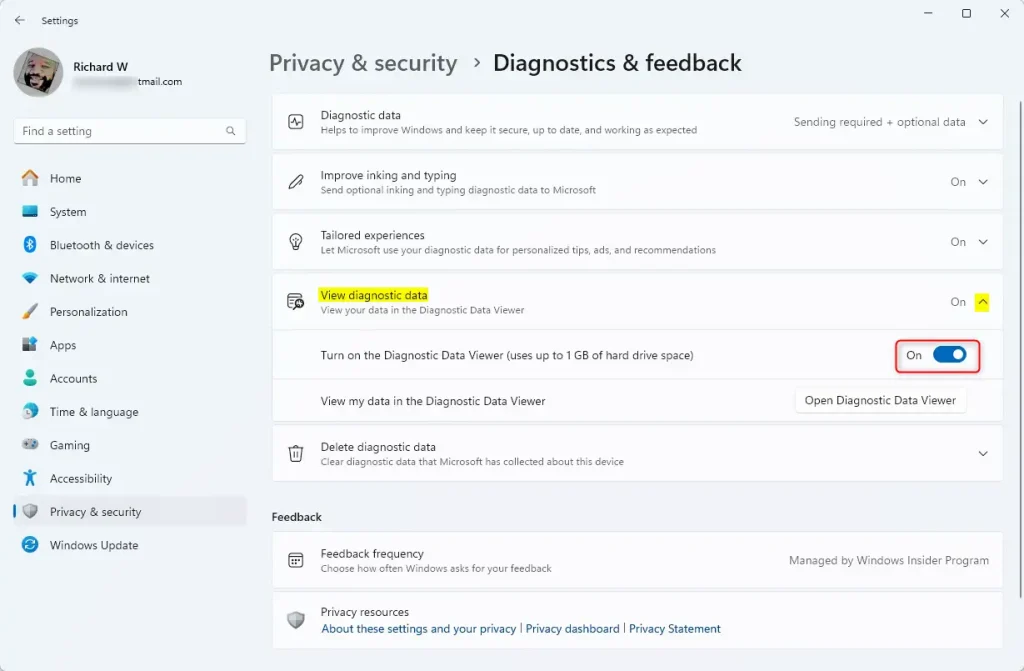
To recap: open Settings, choose Privacy & security, and click Diagnostics & feedback. Next, expand the View diagnostic data tile and use the toggle to turn diagnostic data viewing On or Off. You can close the Settings app once you are finished. To undo the change later, follow the same steps and flip the switch back.
Troubleshooting: Cannot Find or Enable the App
If you cannot locate the Diagnostic Data Viewer in Windows 11, first verify that you have downloaded it from the Microsoft Store. It does not appear in the Start menu until it is installed.
If the app is installed but shows no data, go back to Settings Privacy & security Diagnostics & feedback and check that View diagnostic data is On. The viewer has nothing to display while that switch is off, and it only shows data collected after you turned it on. Also check whether a Group Policy or registry value is blocking the feature, as covered in the sections below.
Enterprise and Privacy Context
Network administrators use Group Policy (a centralized collection of system configurations) to manage these privacy settings across multiple computers. When a policy sets the value, the matching switch in the Settings app is usually greyed out, and a local change will not stick. Home users have no Group Policy Editor and manage these settings directly in Settings.
Your diagnostic data history can also be reviewed online through the Microsoft Privacy Dashboard. Sign in with your Microsoft account to see it.
Data Management and History
The Diagnostic Data Viewer allows you to see what data your Windows 11 device has collected and when it was collected. Use it to check what is being sent, then decide whether you are comfortable with the current privacy settings.
Using the Local Group Policy Editor
The Local Group Policy Editor lets you control the Diagnostic Data Viewer across your system if you use Windows 11 Pro or Enterprise. Windows 11 Home does not include this editor, so Home users should use the Settings app or the registry method instead. This method requires administrator rights and enforces the rule through system policy rather than a per-user switch.
- Open the Start menu , type
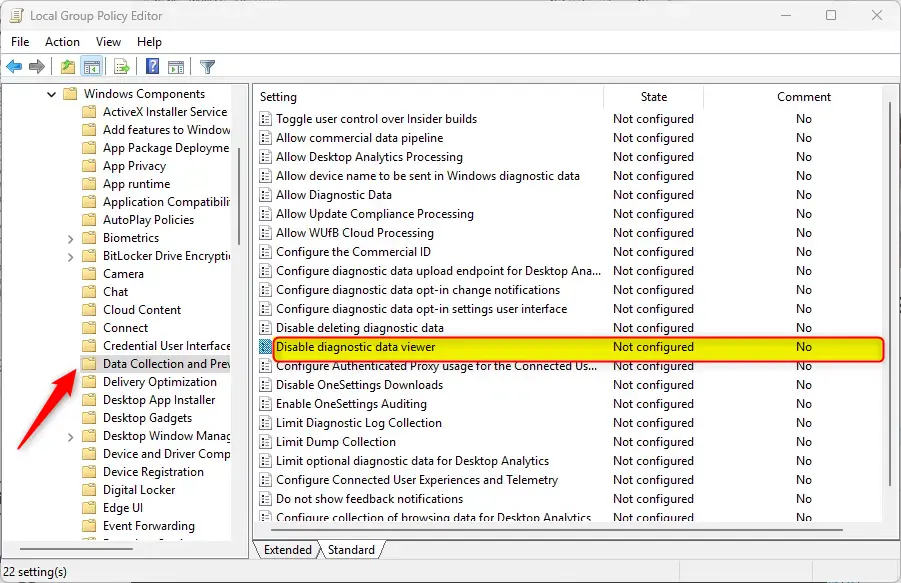
gpedit.msc, and press Enter. If a User Account Control prompt appears, click Yes. The Local Group Policy Editor opens. - In the left pane, navigate to this folder path: Computer Configuration Administrative Templates Windows Components Data Collection and Preview Builds. The policies for that folder appear in the right pane.
- Find Disable diagnostic data viewer in the list and double-click it. A settings window for that policy opens.
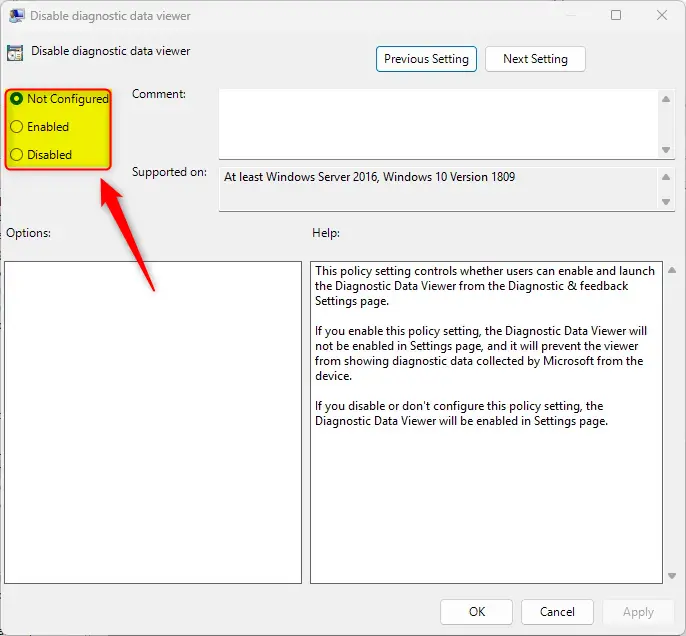
- Choose Not Configured, Enabled, or Disabled. The policy name is a double negative: Enabled switches the viewer off, while Not Configured or Disabled leaves it available to users.
- Click OK to save. You may need to restart your computer for these changes to take effect. To undo the change, open the same policy and set it back to Not Configured.
Using the Registry Editor
It works on every edition, including Home. You need administrator privileges, and you should take care, because mistakes in the registry can cause system problems. Before you start, consider backing up the registry. In Registry Editor, choose File Export to save a copy.
- Open the Windows Registry. Click Yes if User Account Control asks for permission.
- Go to the following path:
HKEY_LOCAL_MACHINE\SOFTWARE\Policies\Microsoft\Windows\DataCollection. You can paste it into the address bar at the top of the window. The values for that key appear in the right pane. - Double-click EnableEventTranscript. The Edit DWORD (32-bit) Value window opens.
- Change the Value data to 1 to turn it on, or 0 to turn it off, then click OK.
- If you do not see this item, right-click in the empty space of the right pane, select New DWORD (32-bit) Value, and name it
EnableEventTranscript. Then double-click the new value and set it as in the previous step.
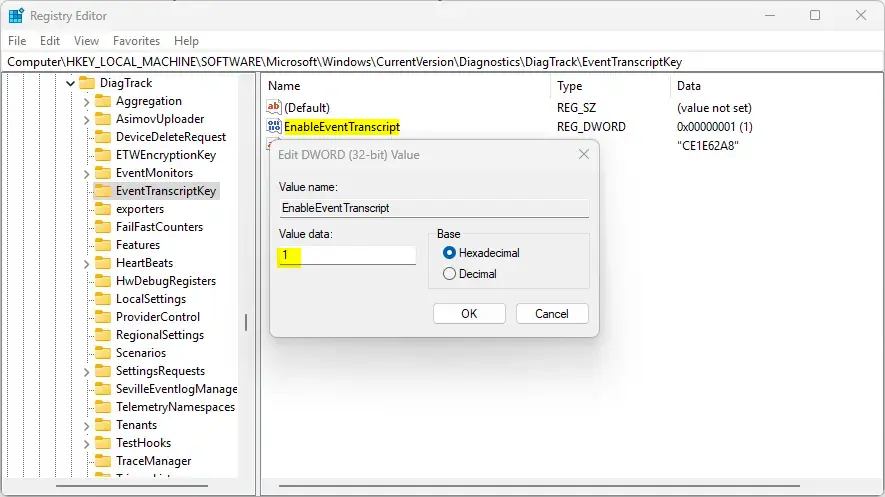
The registry applies your edit when you click OK, but the restart makes sure Windows picks it up. If something goes wrong, set the value back or import the backup you exported.
Summary
Several methods exist for managing the amount of data your Windows 11 computer sends to Microsoft, including the Settings app, the Group Policy Editor and the Registry Editor. The Settings app suits most people and needs no restart. Group Policy suits Pro and Enterprise machines where you want to enforce the rule. The registry works on every edition, Home included, but it needs the most care.
Have a question about this guide?
Answered by AI from this guide. Good questions may be added to this page — please don't include personal details.
Did this guide fix your problem?

About the Author
Richard
Tech Writer, IT Professional
Richard is a writer at Geek Rewind who turns complex IT tasks into clear, step-by-step guides. He draws on years of hands-on experience in system administration and enterprise IT operations, focusing on Windows, Linux and WordPress: the problems people actually run into, and the fixes that work. His server and WordPress guides come from systems he runs himself. Richard builds and maintains the platform behind Geek Rewind, from its Ubuntu servers and Nginx configuration to its custom WordPress plugins. Many new tutorials start with readers' questions, and he's always glad to answer them in the comments.
[…] can turn on or off required or optional diagnostic data collection, turn on or off diagnostic data viewer, enable or disable tailored experiences, and […]