How to Install RustDesk on Ubuntu Linux

RustDesk is a free remote desktop application that lets you control your Ubuntu computer from another device. It works like TeamViewer or AnyDesk, but it also lets you host your own connection server, so your sessions stay under your control.
Stable versions run on Ubuntu 20.04 LTS and newer releases. Once you have the right package file, installing it takes only a few steps. This guide covers the terminal method, the manual Deb file method, how to connect to another machine, how to let someone connect to yours, and the Windows client and web version for the other end of the connection.
Open a terminal with Ctrl+Alt+T and run sudo apt update, then wget to download the rustdesk-1.1.9.deb package from the RustDesk GitHub releases page, then sudo apt install./rustdesk-1.1.9.deb. Use the x86_64 build for most PCs and arm64 for ARM devices. Stable releases need Ubuntu 20.04 LTS or newer.
How to install RustDesk remote desktop support tool on Ubuntu Linux
The fastest way to install RustDesk on Ubuntu is the terminal. You refresh the package list, download the package with wget, and install it with apt. Here is the order:
- Press Ctrl+Alt+T to open a terminal.
- Run the update command first. Ubuntu refreshes its package lists, and it may ask for your password. Nothing shows on screen while you type it, which is normal.
- Run the wget command to download the RustDesk package. Make sure the file matches your CPU type. Most PCs need the x86_64 build, while ARM devices need the arm64 build.
- Run the apt install command on the downloaded file. apt also pulls in any libraries RustDesk needs, so let it finish.
Run the commands below in this order. You need an account with sudo rights.
Wait for the command to finish and return you to the prompt before you run the next one.
Read the output for errors before you continue. A failed download or a typo in the file name will stop the install in the next step.
sudo apt update
wget https://github.com/rustdesk/rustdesk/releases/download/1.1.9/rustdesk-1.1.9.deb
sudo apt install ./rustdesk-1.1.9.deb
If you prefer a graphical install, you can use the Deb file instead. Download the RustDesk Deb file from the link below, then follow these steps:
- Open the folder where the file was saved, usually Downloads.
- Right-click the file and choose Install. On some Ubuntu versions this option is named after the software installer.
- Enter your password when asked, then wait for the installation to finish.
If the right-click option is missing, use the terminal method above. It does the same job and shows you any error message.
Once installed, open RustDesk from the desktop:
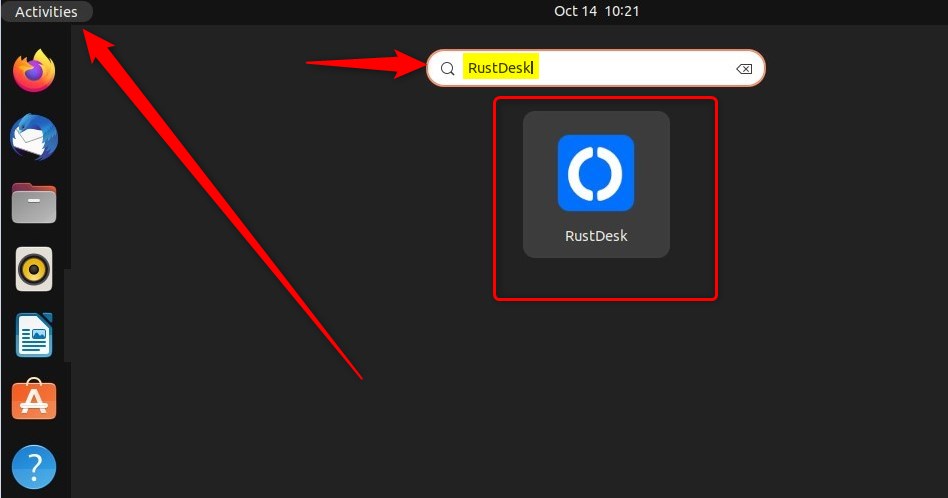
- Open the Activities panel in the top-left corner.
- Type RustDesk in the search box.
- Select the RustDesk icon in the results.
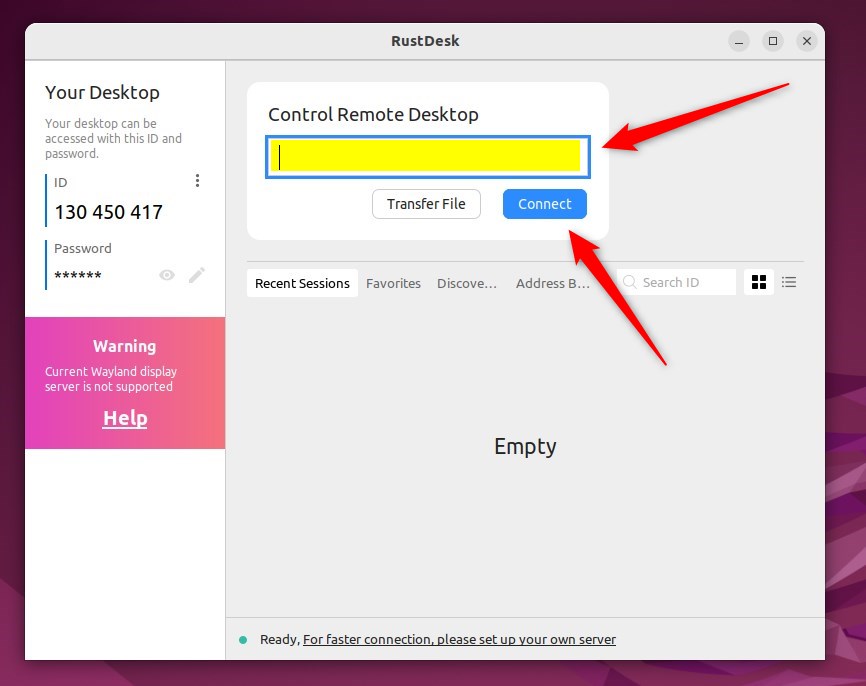
The main window opens and shows your own ID and a password. You will need these later when someone wants to connect to this computer.
To connect to another machine, follow these steps:
- Ask the person on the other computer for their RustDesk ID. That computer must also be running RustDesk.
- Type the ID into the remote ID field in the app.
- Click the Connect button.
- Enter the password when asked. A window then opens with the remote desktop.
If the connection fails, check that the ID is typed correctly and that both computers are online.
Send them only to people you trust, and through a safe channel. Anyone who has both can control your computer.
Newer Ubuntu releases sign in with Wayland by default, and remote control of the screen can be limited there. Signing out and choosing an Xorg session from the gear icon on the login screen often fixes this.
Windows client
The other computer is often a Windows PC. You can download the Windows client directly from the official RustDesk website without administrator permissions. A standard user account can run the file and set up remote access right away, with no system changes and no admin password.
As mentioned above, RustDesk installs on Windows without administrative privileges. This helps on work or school PCs, where you often cannot get admin rights. Check your organization's policy before you use it on a managed computer.
Standard accounts can deploy and run the client without trouble. You download the file, run it, and the app opens with its own ID and password, just like on Ubuntu.
If you cannot install software, or prefer not to, use the web version at http://web.rustdesk.com/ to connect. It runs in your browser, so there is nothing to install.
Type in the remote ID and establish the connection, the same way you do in the desktop app. Enter the password when asked, and the remote screen appears in your browser tab.
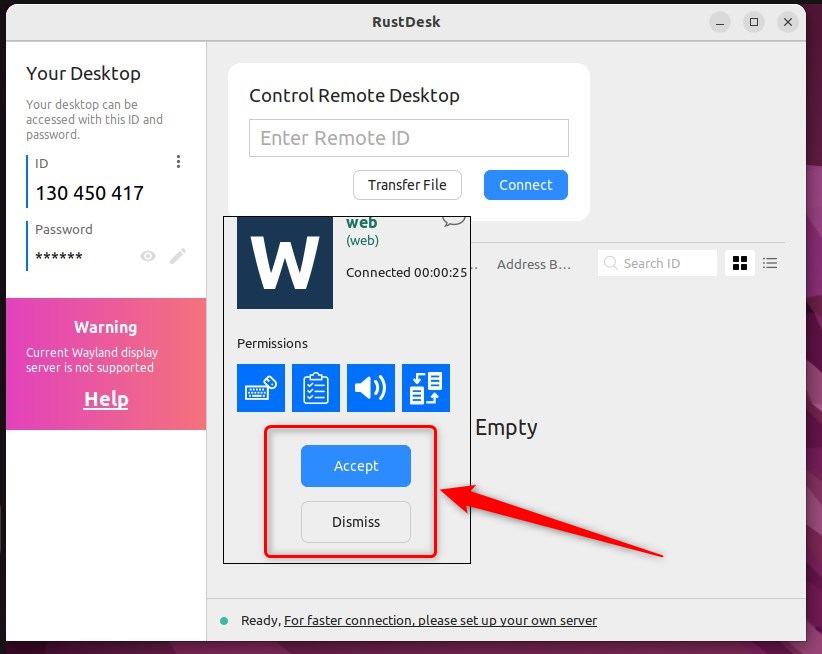
When someone connects to your computer, RustDesk shows a prompt asking you to Accept or Dismiss the request. Click Accept only if you expect the connection. Click Dismiss to refuse it, and the other person stays out.
That completes the setup process. RustDesk is now installed on Ubuntu, and you know how to connect out, accept incoming requests, and use the Windows client or web version on the other side. If you no longer need the app, you can remove it through Ubuntu Software or with apt.
Conclusion:
- RustDesk is a versatile and user-friendly remote desktop tool for accessing and controlling devices from anywhere at any time
- The installation process on Ubuntu Linux is straightforward, and with the Windows client, it can be used without administrative privileges
- RustDesk's end-to-end encryption and easy remote connection make it a reliable choice for secure and efficient remote support
- For those who prefer not to install anything, RustDesk web offers a convenient solution for connecting to remote computers
- Users can contribute feedback or suggestions via the comment section for further enhancements and improvements
Have a question about this guide?
Answered by AI from this guide. Good questions may be added to this page — please don't include personal details.
Did this guide fix your problem?

About the Author
Richard
Tech Writer, IT Professional
Richard is a writer at Geek Rewind who turns complex IT tasks into clear, step-by-step guides. He draws on years of hands-on experience in system administration and enterprise IT operations, focusing on Windows, Linux and WordPress: the problems people actually run into, and the fixes that work. His server and WordPress guides come from systems he runs himself. Richard builds and maintains the platform behind Geek Rewind, from its Ubuntu servers and Nginx configuration to its custom WordPress plugins. Many new tutorials start with readers' questions, and he's always glad to answer them in the comments.
No comments yet — be the first to share your thoughts!