How to Install PyCharm on Ubuntu 24.04

PyCharm is an integrated development environment (an application with tools to write and test code) that helps you build Python programs on Ubuntu 24.04 with smart code completion and built-in debugging tools. You can choose between the free Community edition for basic Python scripts or the paid Professional edition for web and data science projects.
Installing PyCharm on Ubuntu 24.04 takes only a few minutes using either the Ubuntu Snap store or the official tarball download. This setup works on clean desktop installations and requires a standard user account with internet access.
Install PyCharm on Ubuntu 24.04 by running sudo apt install pycharm-community for the free version, or pycharm-professional for the paid version. Alternatively, use `sudo snap install pycharm-community –classic` for the Snap package.
Prepare Ubuntu
Run the command below to update Ubuntu.
sudo apt update
sudo apt upgrade
Install these packages next.
sudo apt install dirmngr ca-certificates software-properties-common apt-transport-https curl lsb-release
Add JetBrains PPA repository
Adding the JetBrains PPA repository to your Ubuntu 24.04 system lets you install PyCharm and receive automatic updates through your system’s package manager. You need to import the official GPG signing key and add the repository source list to your terminal before your system can download and verify the installation files safely.
First, import the repository GPG key by running the command below.
curl -s https://s3.eu-central-1.amazonaws.com/jetbrains-ppa/0xA6E8698A.pub.asc | gpg --dearmor | sudo tee /usr/share/keyrings/jetbrains-ppa-archive-keyring.gpg > /dev/null
Then, add the repository by running the command below.
echo "deb [signed-by=/usr/share/keyrings/jetbrains-ppa-archive-keyring.gpg] http://jetbrains-ppa.s3-website.eu-central-1.amazonaws.com any main" | sudo tee /etc/apt/sources.list.d/jetbrains-ppa.list > /dev/null
Finally, update and install the PyCharm edition for your projects. The community edition is free and has limited features.
Education and Professional editions have more features.
sudo apt update

sudo apt install pycharm-community

sudo apt install pycharm-education

sudo apt install pycharm-professional
Once installed, you can start the different PyCharm editions by running the command below.
pycharm-community

pycharm-professional

pycharm-education
You can also launch it by going to Activities Show Applications PyCharm on the desktop.
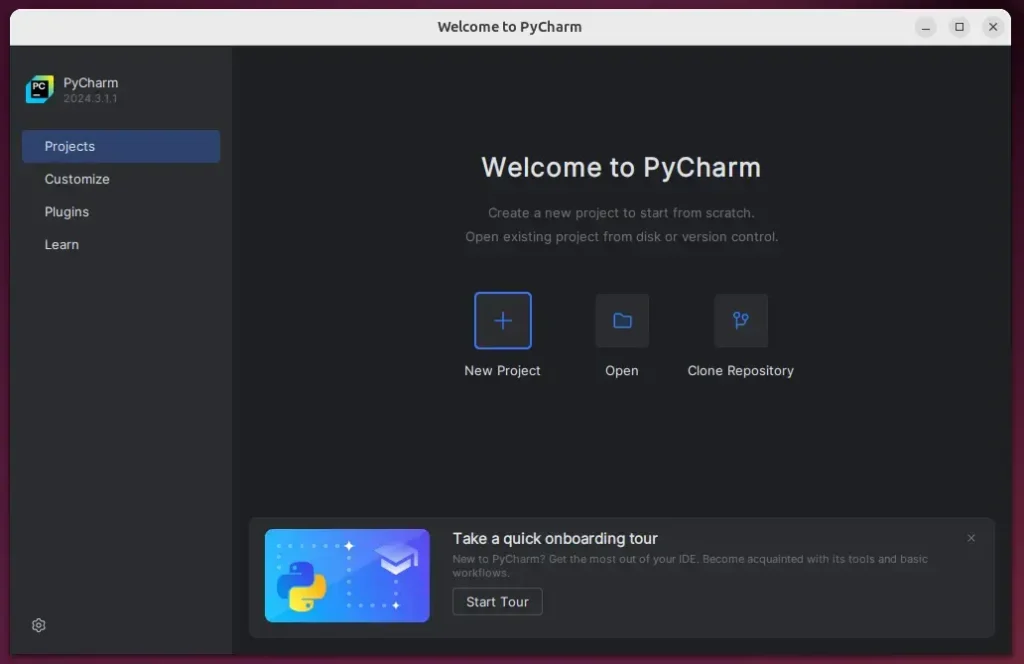
If you want to uninstall the PyCharm edition you installed, use the command below.
sudo apt remove pycharm-community
sudo apt remove pycharm-professional
sudo apt remove pycharm-education
Install PyCharm via Snap
Installing PyCharm via Snap on Ubuntu 24.04 gives you a self-contained application package that includes all necessary dependencies and automatic updates. You can complete the entire setup directly from your terminal using the built-in package manager without needing to manually configure extra software repositories.
To do that, install the Snap package manager if it’s not already installed.
sudo apt install snapd
Next, install core Snap and enable classic support by running the command below.
sudo ln -s /var/lib/snapd/snap /snap
sudo snap install core
Then, run the command below to PyCharm edition for your projects from the Snap package manager.
Education and Professional editions have more features.
sudo snap install pycharm-community --classic

sudo snap install pycharm-professional --classic

sudo snap install pycharm-educational --classic
Once installed, use the Dock on the left sidebar to search and launch the PyCharm app.
You can also run the app using the command below.
snap run pycharm-community

snap run pycharm-professional

snap run pycharm-educational
Remove the app using the command below.
sudo snap remove pycharm-community
sudo snap remove pycharm-professional
sudo snap remove pycharm-educational
Install PyCharm via Flatpak
Installing PyCharm via Flatpak on Ubuntu 24.04 provides a secure and sandboxed environment that keeps the application isolated from your core system files. You first need to add the Flathub repository to your system and then run the standard Flatpak install command to set up the IDE.
Flatpak is a third-party application distribution system that is not included in Ubuntu by default.
You must install the Flatpak package manager and then install PyCharm from there.
First, update and install Flatpak.
sudo apt update && sudo apt upgrade
sudo apt install flatpak
Next, add the Flatpak repository to Ubuntu.
sudo flatpak remote-add --if-not-exists flathub https://flathub.org/repo/flathub.flatpakrepo
Finally, install PyCharm. The education edition is not available on Flatpak.
flatpak install flathub com.jetbrains.PyCharm-Community

flatpak install flathub com.jetbrains.PyCharm-Professional
Once installed, you can launch it using the command below or open the app in the desktop apps center.
flatpak run com.jetbrains.PyCharm-Community

flatpak run com.jetbrains.PyCharm-Professional
Uninstall the app using the command below.
flatpak uninstall --delete-data com.jetbrains.PyCharm-Community
flatpak uninstall --delete-data com.jetbrains.PyCharm-Professional
That should do it!
Conclusion
Installing PyCharm on Ubuntu 24.04 can be accomplished in several straightforward ways. Here are the key takeaways:
- Multiple Installation Methods: You can install PyCharm using APT, Snap, or Flatpak, providing flexibility based on your preferences.
- Editions Available: The Community edition is free, while the Education and Professional editions offer additional features tailored to varied user needs.
- Easy Uninstallation: Uninstalling PyCharm is as simple as executing a command, ensuring you can manage your software easily.
- Enhanced Development Experience: PyCharm enhances productivity with features like intelligent code completion and version control integration.
- User-Friendly Interface: The IDE provides a familiar environment for developers to streamline their coding processes on Ubuntu.
Choosing the correct method and edition of PyCharm can significantly enhance your Python programming workflow on Ubuntu.
Was this guide helpful?

About the Author
Richard
Tech Writer, IT Professional
Richard, a writer for Geek Rewind, is a tech enthusiast who loves breaking down complex IT topics into simple, easy-to-understand ideas. With years of hands-on experience in system administration and enterprise IT operations, he’s developed a knack for offering practical tips and solutions. Richard aims to make technology more accessible and actionable. He's deeply committed to the Geek Rewind community, always ready to answer questions and engage in discussions.


No comments yet — be the first to share your thoughts!