How to List User Profiles and Accounts in Windows 11


User profiles in Windows 11 are individual digital spaces that store personal files, app settings, and desktop layouts for everyone who shares the same computer. Finding these profiles takes more than checking the standard settings menu because Windows hides the actual folder setup.
Every account has its own folder stored inside 📁C:\
View profile folders in File Explorer by navigating to C:Users and enabling hidden items. Use the Command Prompt with `net user` or `wmic useraccount get name,SID` for a technical list. The Registry Editor at 🗝️HKEY_LOCAL_MACHINESOFTWAREMicrosoftWindows NTCurrentVersionProfileList also links accounts to their paths.
Step 1View Profile Folders in File Explorer
To view all profile folders currently on the computer, open File Explorer and navigate to:
C:\Users
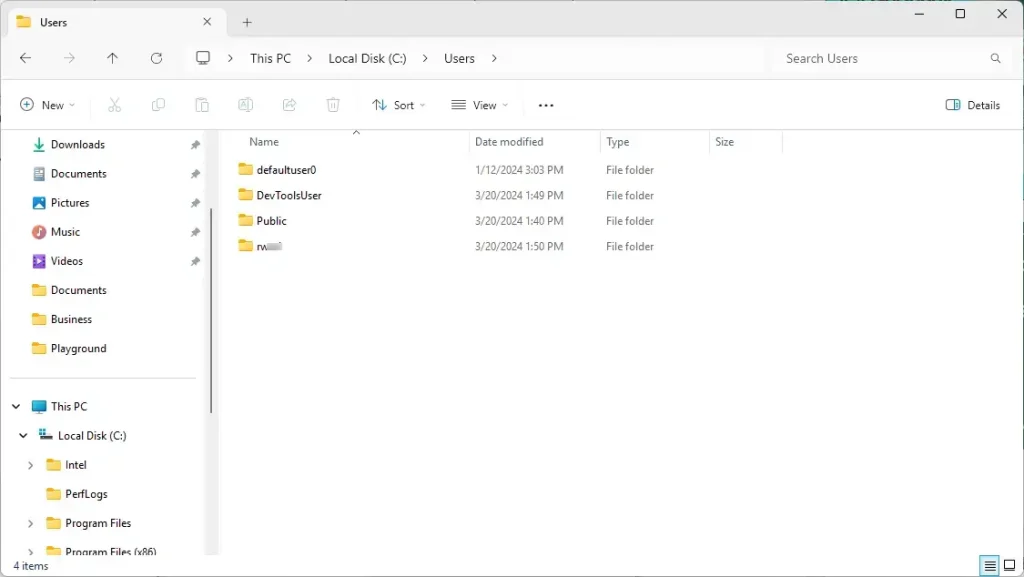
Note that certain directories remain hidden by default. Click the View menu in File Explorer , select Show, and check Hidden items to reveal them.
Step 2Using the Command Line to List Accounts
Windows Terminal lets you list user profiles Windows 11 by running a simple command. Right-click the Start button and select Terminal (Admin) to open the command prompt with elevated rights. Type net user and press Enter to instantly see every local account name set up on your machine.
Open the Windows Terminal with administrator privileges. To list all local user accounts, type the following command and press Enter:
net user
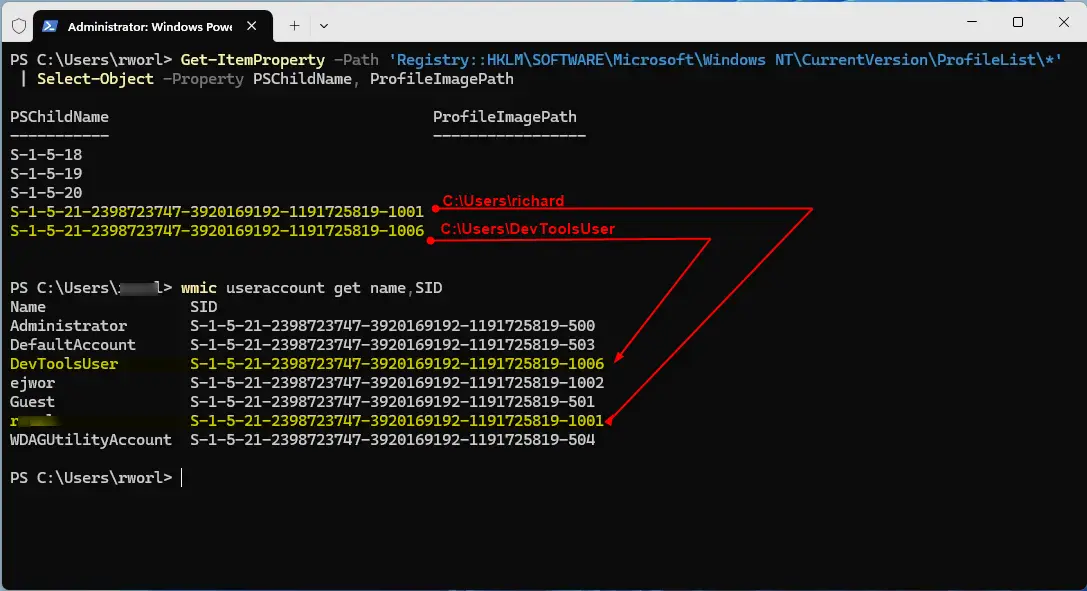
This command reveals a list of account names. To retrieve deeper details, including the Security Identifier (SID)—a unique number identifying each account—use this command:
wmic useraccount get name,SID
Step 3Matching Profiles via Registry Editor
Registry Editor (a database that stores core system settings) helps you match user accounts to their exact folder paths. Open Registry Editor by pressing Win + R, typing regedit, and pressing Enter. Then go to HKEY_LOCAL_MACHINE\SOFTWARE\Microsoft\Windows NT\CurrentVersion\ProfileList to view the Security Identifier (SID) for each profile.
1. Press Win + R, type regedit, and press Enter.
2. Navigate to: HKEY_LOCAL_MACHINE\SOFTWARE\Microsoft\Windows NT\CurrentVersion\ProfileList
3. Click through the folders starting with S-1-5 to examine the ProfileImagePath value.
Step 4Using Advanced Management Tools
Windows 11 Pro and Enterprise editions include a built-in utility called Local Users and Groups for deeper account management. Press Win + R, type lusrmgr.msc, and press Enter. This utility provides a visual interface to manage accounts, disable users, or reset passwords without touching the command line.
Summary
Managing user profiles remains vital for system health. Using the command line, Registry Editor, or Local Users and Groups tool maps user accounts to their folders accurately. This practice clarifies data storage locations and maintains a clean Windows 11 environment.
C:\Users.Doing so corrupts the user profile and triggers a temporary profile upon login, resulting in potential data loss. Always rely on the official Settings app to delete user accounts.
Was this guide helpful?

About the Author
Richard
Tech Writer, IT Professional
Richard is a writer at Geek Rewind who turns complex IT tasks into clear, step-by-step guides. He draws on years of hands-on experience in system administration and enterprise IT operations, focusing on Windows, Linux and WordPress: the problems people actually run into, and the fixes that work. His server and WordPress guides come from systems he runs himself. Richard builds and maintains the platform behind Geek Rewind, from its Ubuntu servers and Nginx configuration to its custom WordPress plugins. Many new tutorials start with readers' questions, and he's always glad to answer them in the comments.

[…] account name, the profile folder will not reflect the account’s new name. You may want to list and match the profile folder to the account name to ensure you’re not deleting the wrong […]