How to Install LAMP on Google Cloud Server

A LAMP stack on a Google Cloud server lets you host dynamic websites and applications like WordPress on a fast, reliable web server. LAMP stands for Linux, Apache, MySQL, and PHP, which is a bundle of four open-source tools used to run websites.
Connect to your Google Cloud server via SSH. Then, update your package list with sudo apt update and install Apache, MySQL, and PHP using sudo apt install apache2 mysql-server php libapache2-mod-php php-mysql.
You can run this entire setup on a Google Cloud virtual machine using Ubuntu Linux version 22.04 or later. This configuration gives you complete control over your own web hosting environment.
- How to create a website domain
- How to set up a Google Cloud server with Ubuntu Linux
- How to install Apache on a Google Cloud server (alternative to Nginx)
- How to install Nginx on Google Cloud server (alternative to Apache)
- How to install PHP on a Google Cloud server
- How to install MySQL or MariaDB database server
This setup relies on several foundational pieces:
- Setting up a domain and a Google Cloud server with Ubuntu Linux
- Installing either Apache or Nginx as the web server
- Adding PHP for dynamic content
- Setting up MySQL or MariaDB for database storage
Administrators can continue below to tie everything together with any platform that uses the LAMP stack.
A web server allows content to be published and served to web clients and audiences browsing a website. A PHP or server-side scripting language allows for a dynamic and more functional website. A database server enables administrators to store website content efficiently.
Other software and packages may also be needed to enhance website functionality. Below, this guide demonstrates how to install these tools with LAMP-based websites and applications.
A domain name cannot be used until it is forwarded or pointed to a server. Previous steps showed how to point a domain to a newly created server. After that, administrators learned how to install software and packages to help run a website online.
Connecting to the Google Cloud server lets administrators install LAMP by tying together the software and packages installed in previous posts.
How to connect to Google Cloud servers
Browser-based SSH (Secure Shell) lets you connect directly to a Google Cloud Compute Engine virtual machine (VM) instance through the Google Cloud Console.
SSH from the browser supports the following:
- Web browsers
- The latest version of Google Chrome
- Firefox
- Microsoft Edge
- Microsoft Internet Explorer 11 and later
- Safari 8 and later. Note that Safari in private browser mode is not supported.
- Virtual machine configurations
- All Linux VM images are natively available in Google Cloud.
Google Cloud offers all Linux VM images directly for virtual machine configurations. Extra software or browser extensions are unnecessary. Log in to the Google Cloud Console, then navigate to Menu Compute Engine VM instances.
In the list of virtual machine instances, click SSH in the row of the instance to connect to.

Alternatively, click the instance name and select SSH from the details page.
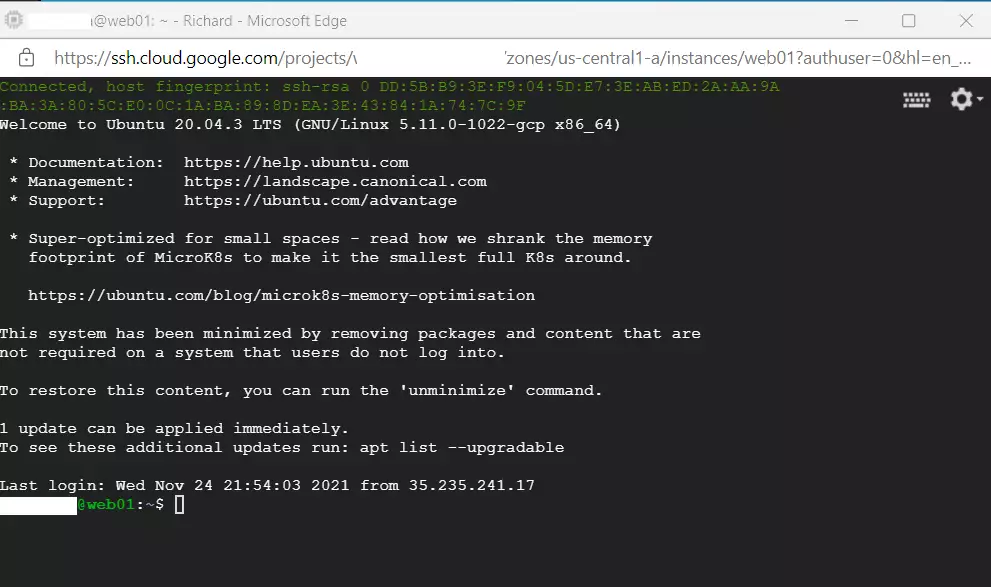
An SSH terminal window with the Ubuntu Linux instance created in the second post of the series will open.
Administrators can now run commands in Ubuntu Linux created on the Google Cloud server.
How to install the LAMP stack on Google Cloud Servers
Installing and managing the LAMP stack on Ubuntu Linux remains identical across Google Cloud servers or local VM instances.
All previous posts relate to installing LAMP, except for Nginx configurations. LAMP stands for Linux (Ubuntu), Apache, MySQL or MariaDB, and PHP.
Once required packages are installed, accessing the LAMP stack from a browser happens by navigating to the server hostname or IP address.
A detailed post below helps administrators install the LAMP stack on Ubuntu Linux. Use this link to learn more about LAMP.
How to install LAMP on Ubuntu Linux
That completes the setup process.
Conclusion:
Running LAMP on Ubuntu Linux gives you a reliable platform to build and manage web applications. Here are the key points to remember:
- LAMP Components: LAMP stands for Linux, Apache, MySQL/MariaDB, and PHP/Perl/Python, forming a robust foundation for web development.
- Connectivity: You can easily connect to your Google Cloud server using SSH from any supported web browser.
- Installation Steps: Follow our previous guides to set up the necessary components and install the LAMP stack efficiently.
- Dynamic Websites: With the LAMP stack, you can build dynamic websites that handle complex functionalities.
- Further Learning: Explore our detailed guides for each component to deepen your understanding and refine your setup.
Mastering the LAMP stack sets the stage for developing powerful web applications that can reach a global audience.
Was this guide helpful?

About the Author
Richard
Tech Writer, IT Professional
Richard, a writer for Geek Rewind, is a tech enthusiast who loves breaking down complex IT topics into simple, easy-to-understand ideas. With years of hands-on experience in system administration and enterprise IT operations, he’s developed a knack for offering practical tips and solutions. Richard aims to make technology more accessible and actionable. He's deeply committed to the Geek Rewind community, always ready to answer questions and engage in discussions.
No comments yet — be the first to share your thoughts!