How to Check for Neural Processing Units in Windows 11

A Neural Processing Unit (NPU) is a specialized chip designed to accelerate artificial intelligence tasks. You can check whether your Windows 11 computer has one in a few minutes. This guide covers the processor name, Task Manager and Device Manager.
Open Task Manager and go to the Performance tab to see an NPU section. Alternatively, open Device Manager and look for a “Neural processors” category. If you have a compatible chip, ensure your manufacturer drivers are installed.
What is a Neural Processing Unit?
A Neural Processing Unit, or NPU, is a specialized chip designed to accelerate Artificial Intelligence (AI) tasks. It acts as a dedicated helper for functions like voice commands or image enhancements. A CPU or GPU handles general workloads. An NPU focuses strictly on AI math.
NPU performance is measured in TOPS (Trillions of Operations Per Second). Higher numbers mean faster local AI processing. When you compare machines, the TOPS figure on the spec sheet is the number to look at.
An NPU lets a PC run AI features faster and use less battery, because the work moves off the main processor. This matters for features like real-time translation and advanced photo editing, particularly those found in Copilot+ PCs.
Quick Check: Do You Have an NPU?
Windows 11 has built-in tools that show whether this chip is present. Start with the processor name, then confirm with Task Manager or Device Manager. Together they tell you whether the hardware includes a dedicated AI accelerator.
- Check your CPU: Look for Intel Core Ultra (AI Boost), AMD Ryzen 8000/9000 series (Ryzen AI), or Qualcomm Snapdragon X series. If your processor is not on this list, it most likely has no NPU.
- Task Manager : Open it and see whether an NPU entry exists on the Performance tab.
- Device Manager: Check for a Neural processors category.
If a supported chip does not show up, update the drivers (chipset and NPU drivers from the PC or chip maker, or through Windows Update ), then check again. Task Manager only shows the NPU on recent versions of Windows 11, so an older build may hide a chip that is really there.
How to Check for NPU Using Task Manager
- Open Task Manager by pressing
Ctrl+Shift+Esc. The Task Manager window opens. - Click the Performance tab. A list of hardware such as CPU, Memory, Disk and GPU appears on the left.
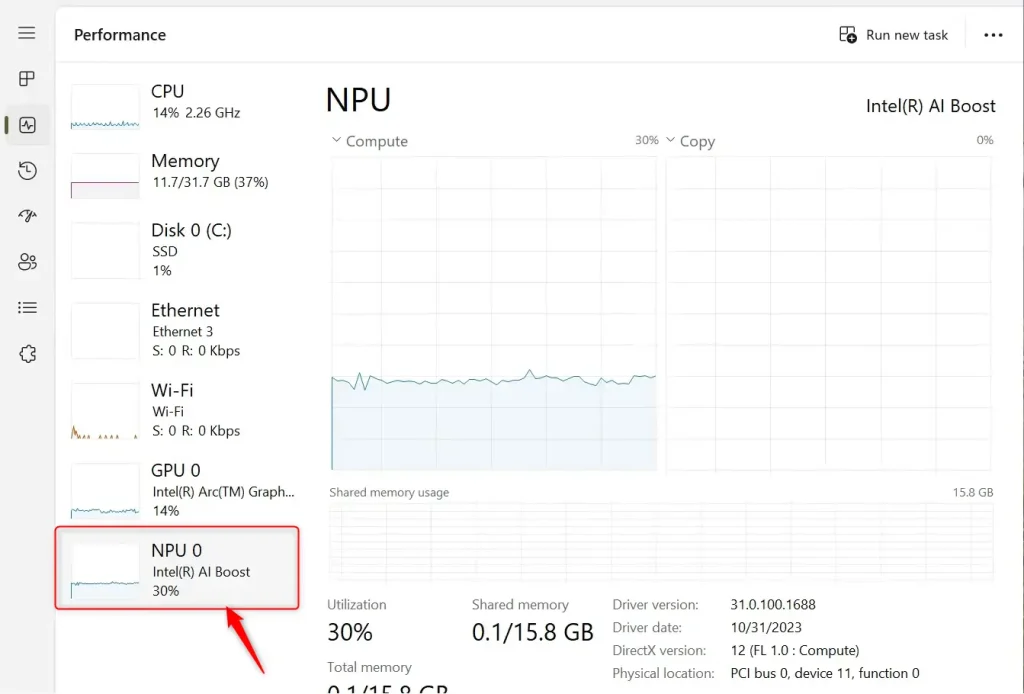
- Look through that list for an NPU entry. If your PC has an NPU, you will see it with its name and current usage. Click it to see a utilization graph.
- If there is no NPU entry, the PC may have no NPU, the driver may be missing, or your Windows 11 version may be too old to show it. Check Device Manager next.
The NPU graph usually sits near zero until an app uses AI features, so low usage is normal and does not mean a fault.
How to Check for NPU Using Device Manager
⚙️ Admin Required: Administrator rights are needed for any change you make here, such as updating or reinstalling a driver. Device Manager usually opens for standard users in read-only mode, so you can often view the hardware list without them.
- Press
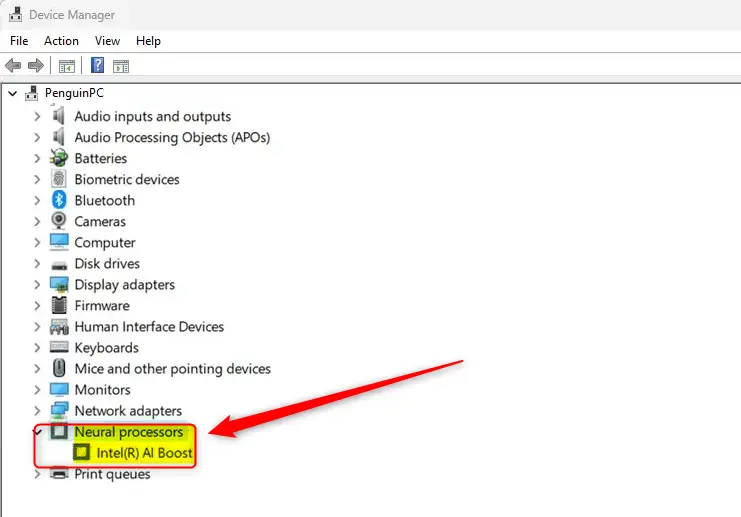
Win + Xand select Device Manager, or typedevmgmt.mscin the search bar. The Device Manager window opens with a list of hardware categories. - Look for a category named Neural processors.
- Expand this category to see your specific hardware, such as Intel AI Boost or Qualcomm Hexagon.
- If you do not see the category, the NPU driver may not be installed. Look for an unknown device or a warning icon elsewhere in the list, then install the driver from your PC or chip manufacturer.
Hardware-Specific Verification
Manufacturers use different names for their AI accelerators, so the name in Windows may not match the one on the spec sheet. Intel's NPU appears in Windows as Intel AI Boost, but Intel's documentation may also refer to it as a VPU (Movidius). The official product pages confirm the exact specifications of your model.
Summary
Confirming that an NPU is present tells you whether the PC is ready for modern AI features. Task Manager gives a quick look at NPU usage. Device Manager confirms the exact model. Keep your drivers current so Windows 11 recognizes the NPU correctly.
Was this guide helpful?

About the Author
Richard
Tech Writer, IT Professional
Richard is a writer at Geek Rewind who turns complex IT tasks into clear, step-by-step guides. He draws on years of hands-on experience in system administration and enterprise IT operations, focusing on Windows, Linux and WordPress: the problems people actually run into, and the fixes that work. His server and WordPress guides come from systems he runs himself. Richard builds and maintains the platform behind Geek Rewind, from its Ubuntu servers and Nginx configuration to its custom WordPress plugins. Many new tutorials start with readers' questions, and he's always glad to answer them in the comments.

[…] use Windows Studio Effects with Voice Focus, the device must have a neural processing unit (NPU) in the new Windows Copilot+ […]
[…] feature uses the Neural Processing Unit (NPU) to generate images locally on your […]
[…] version: Uses smart AI technology on a special chip called a Neural Processing Unit (NPU) for even better noise […]