How to Connect to Hidden WiFi in Windows 11

A hidden WiFi network is a wireless connection that does not broadcast its name (SSID). Because of that, it never shows up in the list of available networks in Windows 11. To connect to one, you need three things: the exact network name, the security type, and the security key (the password). You can get all three from the router’s settings page or from whoever manages the network.
Enter these details correctly once and Windows saves them as a known network. After that, your PC reconnects on its own whenever it is in range. Two methods are covered below, plus a short troubleshooting list.
Manually add the hidden network by going to Settings Network & internet Wi-Fi Add network. Enter the network name (SSID), security type, and password, then click Save. Ensure “Connect automatically” and “Connect even if this network is not broadcasting” are checked.
How to connect to a hidden WiFi network
This is the quickest method. The Settings app lets you type in the network name, security type and password yourself, because Windows can’t discover the network on its own. The path is Settings Network & internet Wi-Fi Manage known networks Add network. Make sure Wi-Fi is turned on and Airplane mode is off before you start.
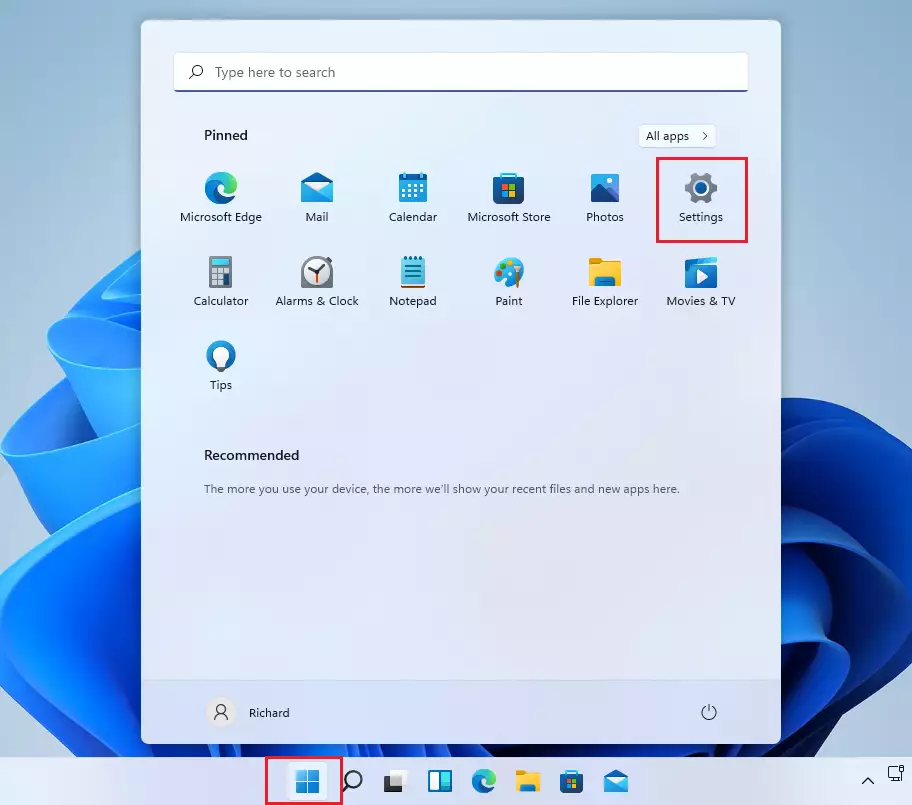
- Open the Settings app. Press Win+I, or click Start and then Settings. The Settings window opens.
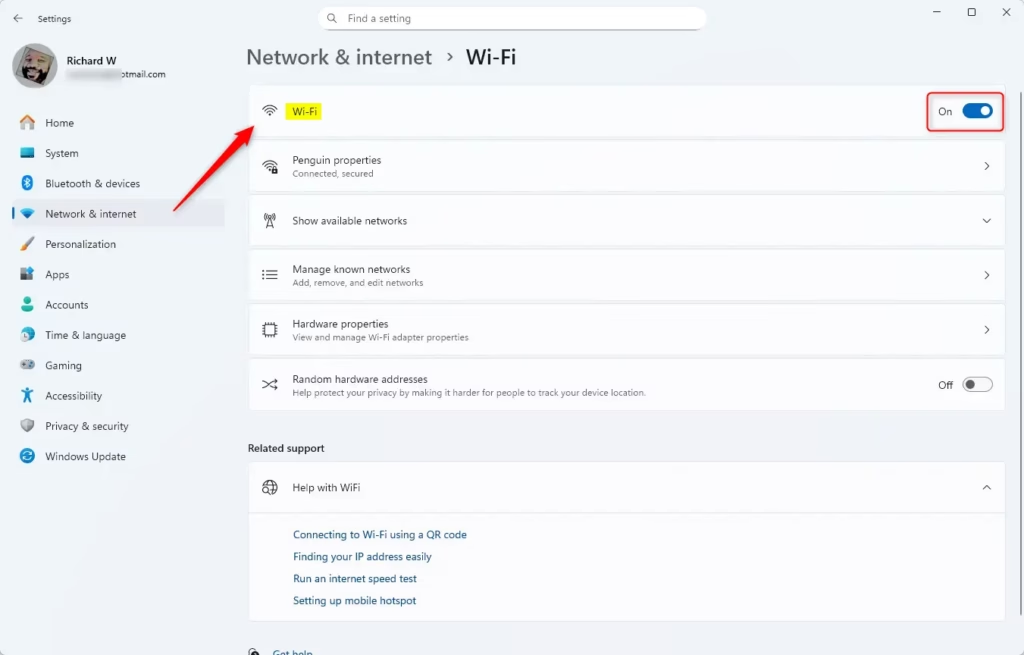
- Click Network & internet on the left. Then click WiFi on the right. If you don’t see it, your PC may have no wireless adapter, or the adapter may be disabled. The Wi-Fi page lists your adapter settings and nearby networks.
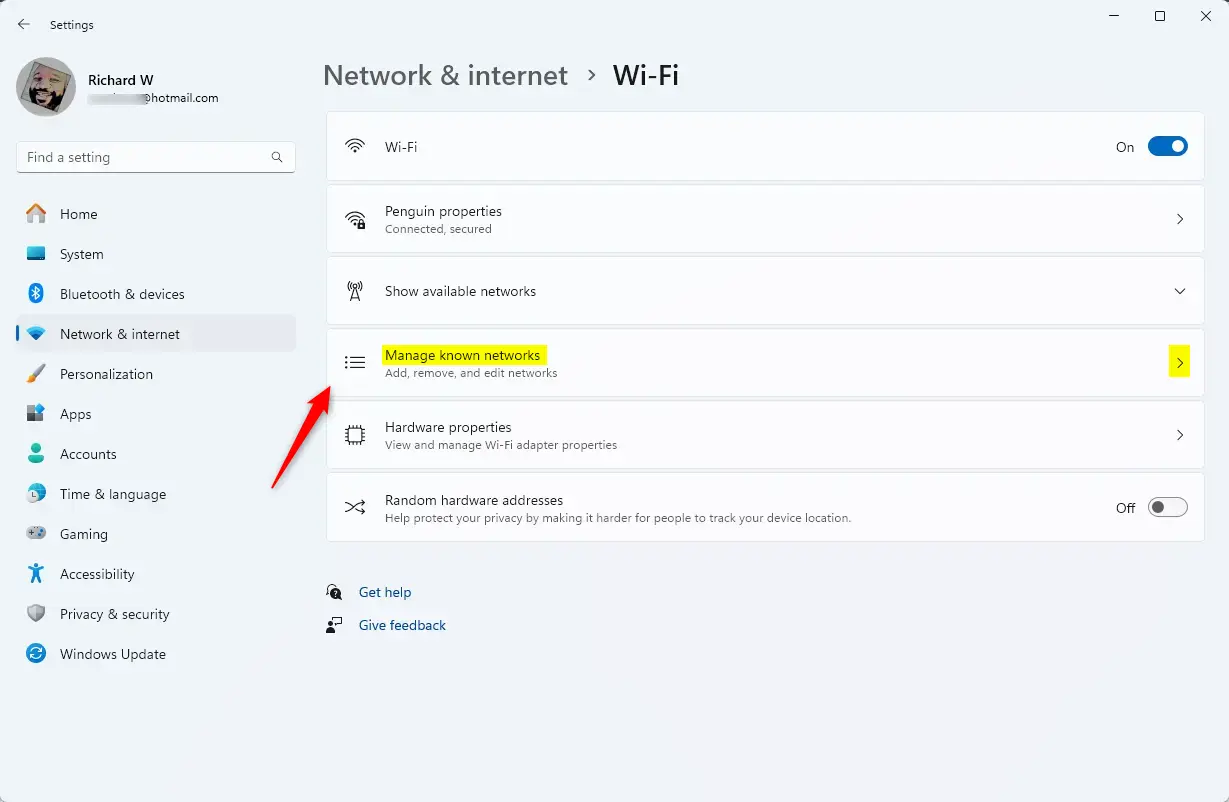
- Click Manage known networks. You see the list of networks your PC has already saved.
- Click the Add network button. A form opens where you enter the network details.
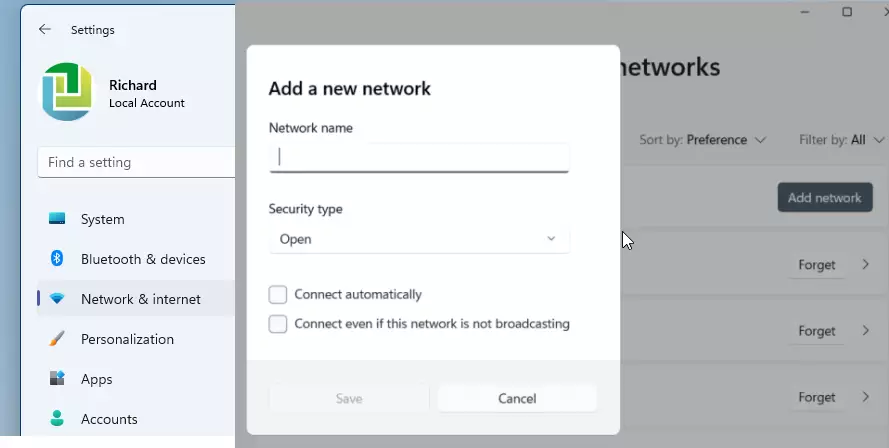
Fill in the form with the details exactly as the router has them. Network names and passwords are case-sensitive, so “HomeNet” and “homenet” are different networks.
- Type the name in the Network name (SSID) box.
- Pick the right option from Security type, for example WPA3-Personal or WPA2-Personal. It must match what the router uses. If you are not sure, check the router’s wireless security page.
- Type the password in the Security key box.
- Tick Connect automatically so Windows reconnects each time the network is in range.
- Tick Connect even if this network is not broadcasting. This is the setting that matters most for a hidden network. Windows has to probe for the network by name, because it never appears in the broadcast list.
- Click Save. Windows stores the network and tries to connect. If it works, the Wi-Fi icon in the taskbar shows you are connected.
To undo this later, go back to Manage known networks, select the network and click Forget. No restart is needed at any point.
Manually adding a network via Control Panel
The Control Panel wizard is a good fallback if the Settings app does not connect to your hidden network, or if the Add network form gives you trouble. It asks for the same details, but through an older wizard that works on both Home and Pro.
- Press Win+R, type ncpa.cpl and press Enter. The Network Connections window opens.
- Go to Network and Sharing Center Set up a new connection or network. If the Network Connections window does not offer a link to it, open Control Panel Network and Internet Network and Sharing Center instead, and click Set up a new connection or network.
- Select Manually connect to a wireless network and click Next.
- Enter the network name, security type and security key. Tick Start this connection automatically and Connect even if the network is not broadcasting. Then click Next to finish. A message confirms the network was added, and you can click Close.
Troubleshooting hidden network connection failures
When a hidden network will not connect, the cause is nearly always a small mismatch. The checks below cover the usual ones. Work through them in order and test the connection after each fix.
- Frequency Mismatch: Your router might be on 5GHz while your adapter only supports 2.4GHz.
- Driver Issues: Outdated drivers can block connections. Right-click Start, select Device Manager, and update your wireless adapter under Network adapters.
- WLAN AutoConfig: Ensure the service is running. Press Windows key + R, type
services.msc, find WLAN AutoConfig, and ensure it is set to Automatic.
If a wrong entry is already saved, Windows keeps using it. Go to Settings Network & internet Wi-Fi Manage known networks, click the network, choose Forget, and add it again with the correct details.
For driver problems, open Device Manager, expand Network adapters, right-click your wireless adapter and choose Update driver. You can also check Settings Windows Update Advanced options Optional updates for a newer driver. Restart the PC after a driver update. An old adapter may also not support WPA3, so try WPA2-Personal if the router offers it.
Summary
To connect to a hidden WiFi network in Windows 11, add the network manually through Settings or, as a fallback, through the Control Panel wizard. Enter the name, security type and password exactly, and turn on the option to connect even when the network is not broadcasting. If it still fails, check for typos, the 2.4GHz and 5GHz bands, and the wireless driver.
Why does my laptop see other networks but not my hidden one?
Have a question about this guide?
Answered by AI from this guide. Good questions may be added to this page — please don't include personal details.
Did this guide fix your problem?

About the Author
Richard
Tech Writer, IT Professional
Richard is a writer at Geek Rewind who turns complex IT tasks into clear, step-by-step guides. He draws on years of hands-on experience in system administration and enterprise IT operations, focusing on Windows, Linux and WordPress: the problems people actually run into, and the fixes that work. His server and WordPress guides come from systems he runs himself. Richard builds and maintains the platform behind Geek Rewind, from its Ubuntu servers and Nginx configuration to its custom WordPress plugins. Many new tutorials start with readers' questions, and he's always glad to answer them in the comments.
No comments yet — be the first to share your thoughts!