How to Enable ‘Speak for Me’ in Windows 11


Speak for Me is an accessibility tool in Windows 11 that builds a personal voice clone to read typed text aloud during chats and online meetings. It first appeared in Windows 11 build 26052. It is hidden by default, so you need a free utility called ViVeTool to switch it on.
Microsoft is still testing this feature. You may run into bugs, or it may not work on your PC yet. Don’t rely on it for anything important.
To enable ‘Speak for me’ in Windows 11, use ViVeTool to enable feature ID 47123936. Once activated, toggle it on or off using the Win+Ctrl+T shortcut or via Settings Accessibility Speech
Enable or disable “Speak for me” in Windows
ViVeTool is a small command-line tool that turns on unreleased features Microsoft has built into Windows but not yet made visible. To enable Speak for Me, you open Command Prompt as an administrator, go to the folder where you extracted ViVeTool, and run one command.
If you have not used ViVeTool before, read the guide below first. It covers downloading the tool, extracting it, and using it to enable or disable hidden features.
How to enable or disable hidden features in Windows with ViVeTool.
Once ViVeTool is ready, run the command below to enable “Speak for me.” You need an administrator Command Prompt for this to work. If you see an access error, close the window and reopen it with Run as administrator.
vivetool /enable /id:47123936
The command should report that the feature configuration was set successfully. Restart your PC afterwards, because hidden features usually don't appear until you do. To undo the change later, run the same command with /disable in place of /enable, then restart again.
Once the feature is enabled, you can turn it on or off with a keyboard shortcut or from Settings. Both methods are below.
Turn on "Speak for me" using the keyboard shortcuts
The quickest way to turn "Speak for me" on or off is the keyboard shortcut.
- Press the
Windows logo key + Ctrl + Tkeys (Windows logo key + Ctrl + T) to toggle "Speak for me" on or off. - Press the same keys again to switch it back.
If nothing happens, the feature is probably not active on your build yet. Check that you restarted after running ViVeTool. Also check that you are on a build that includes the feature, such as build 26052 or later.
Turn "Speak for me" on or off using the Windows Settings app
Once the feature is unlocked, you can also manage it from the Windows Settings app. You don't need to use Command Prompt again. The switch lives in the Accessibility pages.
- Open the Windows Settings app. The quickest way is to press Windows Key + I. You can also click Start and select Settings.
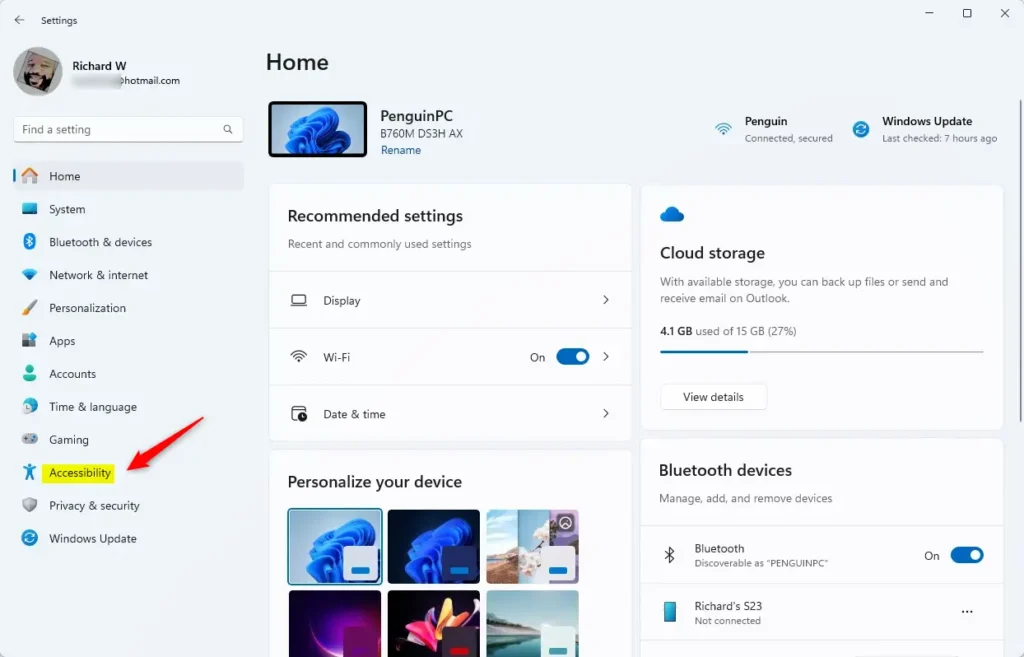
- When the Settings app opens, click the Accessibility button on the left. The accessibility options appear on the right.
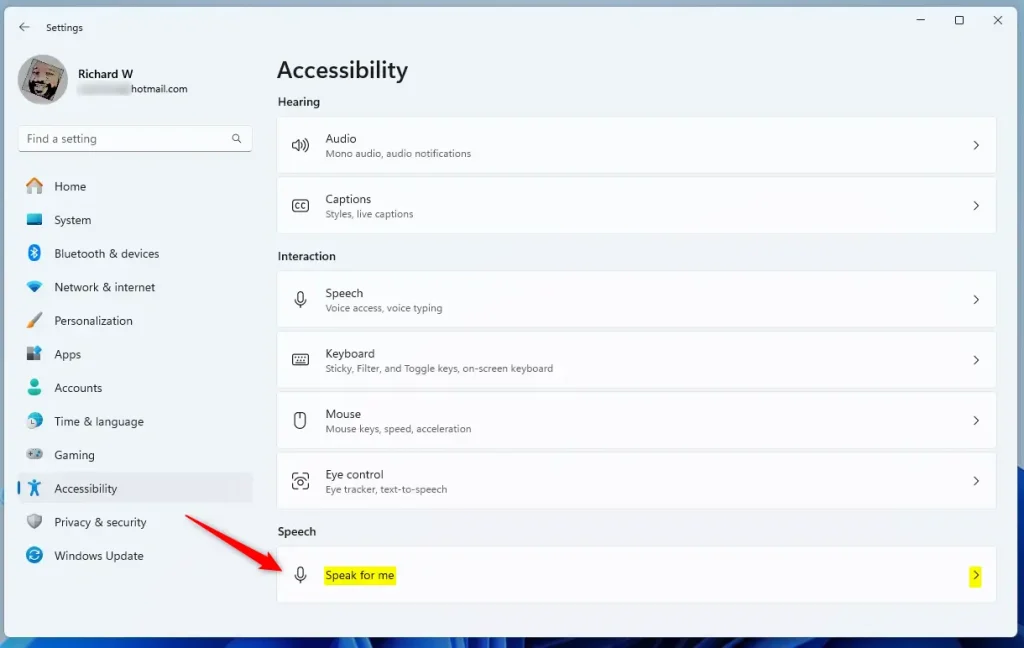
- On the right, find the Speech section. Select the "Speak for me" tile to open it.
If you don't see the tile, the feature is not enabled on your PC. Go back to the ViVeTool step, confirm the command succeeded, and restart.
- On the "Speak for me" page, move the switch to On to enable it.
- To disable it, move the switch to Off.
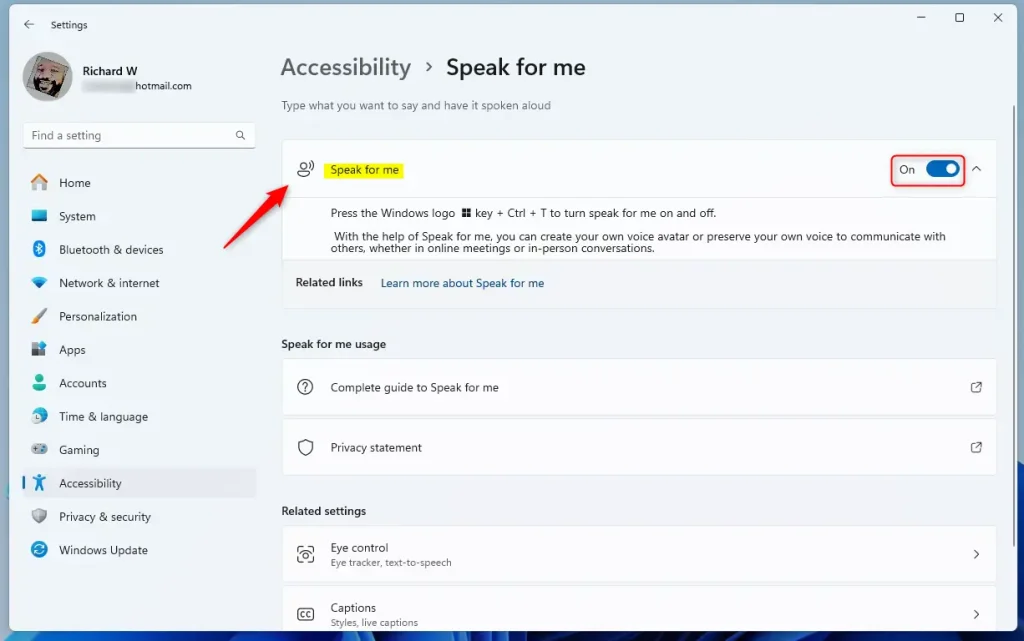
Close the Settings app when you're done. The change applies right away, with no restart needed.
Conclusion:
- The "Speak for me" feature in Windows 11 is a work in progress and does not currently work.
- Users can enable or disable the hidden "Speak for me" feature using ViVeTool. Restart the PC after changing it.
- The keyboard shortcut (Windows logo key + Ctrl + T) gives a quick toggle for "Speak for me."
- Alternatively, users can open the Windows Settings app, go to the Accessibility section, and turn "Speak for me" on or off there.
The "Speak for me" feature is still a work in progress and may not function reliably.
Was this guide helpful?

About the Author
Richard
Tech Writer, IT Professional
Richard is a writer at Geek Rewind who turns complex IT tasks into clear, step-by-step guides. He draws on years of hands-on experience in system administration and enterprise IT operations, focusing on Windows, Linux and WordPress: the problems people actually run into, and the fixes that work. His server and WordPress guides come from systems he runs himself. Richard builds and maintains the platform behind Geek Rewind, from its Ubuntu servers and Nginx configuration to its custom WordPress plugins. Many new tutorials start with readers' questions, and he's always glad to answer them in the comments.




No comments yet — be the first to share your thoughts!