How to Activate Microsoft Defender Antivirus in Windows 11

Microsoft Defender Antivirus is the built-in security program in Windows 11. It scans files, watches for threats in the background and blocks malware. Sometimes you need to change its status, for example after you install another antivirus program or while you troubleshoot a problem.
Windows 11 lets you turn Microsoft Defender Antivirus off and back on yourself. Defender switches itself off automatically when you install a different antivirus program, so in most cases you don’t need to do anything. You can also turn it off by hand if you need to. When Defender is off, its “Periodic Scanning” feature, which checks for threats in the background, is off too.
Before you start, keep these points in mind:
- You need administrator rights to make these changes.
- You must turn off “Tamper Protection” first. This feature stops other programs and unwanted changes from altering your security settings, and it will block your change if it is still on.
- Recent Windows 11 builds can be strict about this. Even with the setting changed, Defender may still run, or Windows may turn it back on later. If that happens, it is the system protecting itself, not a mistake in your steps.
This guide covers two methods. The first uses the Local Group Policy Editor, which is available on Windows 11 Pro, Enterprise and Education. The second uses the Registry Editor, which works on every edition, Home included. Both methods also show how to turn Defender back on.
Open the Local Group Policy Editor by pressing Win+R, typing gpedit.msc and pressing Enter. Go to Computer Configuration Administrative Templates Windows Components Microsoft Defender Antivirus, double-click Turn off Microsoft Defender Antivirus, and select Enabled to turn Defender off. Turn off Tamper Protection first, and use Disabled to turn it back on.
Method 1Using the Local Group Policy Editor (🪟 Windows 11 Pro, Enterprise, Education)
The Local Group Policy Editor lets you manage Microsoft Defender Antivirus settings through a normal window. It is available in Windows 11 Pro, Enterprise and Education, and it gives you direct control over how the antivirus behaves.
This method does not work on Windows 11 Home. Home does not include the Local Group Policy Editor. If you run Home, skip to the Registry Editor method. To check your edition, go to Settings System About and look under Windows specifications.
Turn off Tamper Protection before you start. The steps for that are in the registry method further down. They are the same on every edition.
Step 1Open the Local Group Policy Editor
You open the editor from the Run box. Sign in with an administrator account first.
- Press the Windows key and the R key together. The small Run window opens.
- Type
gpedit.mscinto the box. - Press Enter or click OK. The Local Group Policy Editor opens.
If Windows says it cannot find the file, you are most likely on Windows 11 Home. Use the registry method instead.
Step 2Find the Microsoft Defender Settings
The folders you need are in the left pane. Open them in this order:
- Click Computer Configuration.
- Click Administrative Templates.
- Click Windows Components.
- Find and click Microsoft Defender Antivirus.
The list of Defender settings now appears in the right pane.
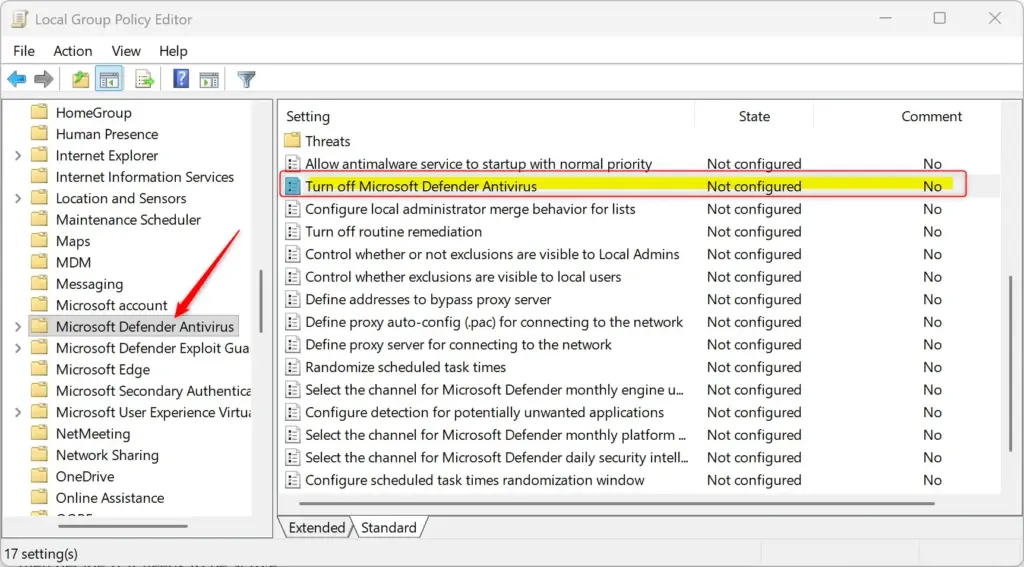
Step 3Find the "Turn off Microsoft Defender Antivirus" Setting
The setting you want is in the right pane of the Local Group Policy Editor window.
- Scroll down the list until you find Turn off Microsoft Defender Antivirus.
- Double-click Turn off Microsoft Defender Antivirus.
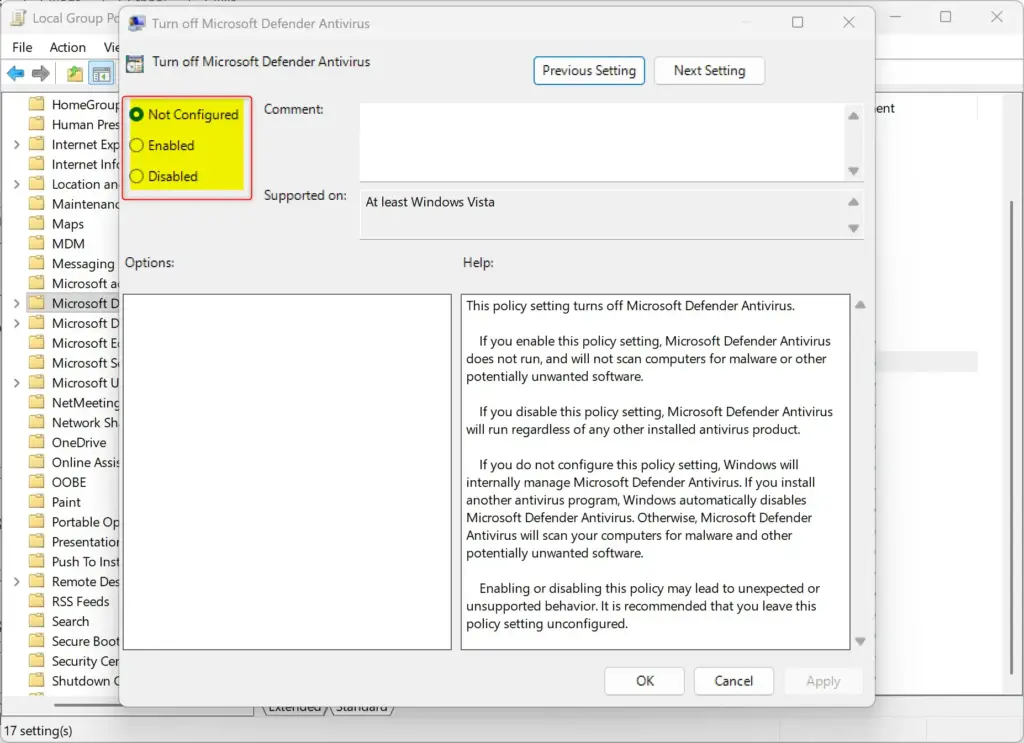
A configuration window opens with three options at the top left and a short description on the right.
Step 4Choose Whether to Enable or Disable
This window controls how Windows handles Defender. The wording is easy to mix up, because the policy is called "Turn off." Enabled means the "turn off" rule is active, so Defender is turned off. Disabled means the rule is not applied, so Defender keeps running. Not Configured lets Windows decide.
- Not Configured: This is the default. Windows decides what to do, usually turning off Defender if another antivirus is active.
- Enabled: If you choose this, you are telling Windows to turn off Microsoft Defender Antivirus.
- Disabled: If you choose this, you are telling Windows to keep Microsoft Defender Antivirus running.
To turn off Microsoft Defender Antivirus:
- Select the circle next to Enabled.
- Click Apply.
- Click OK.
To turn on Microsoft Defender Antivirus (or make sure it's running):
- Select the circle next to Not Configured or Disabled. Not Configured is usually the better choice because it lets Windows manage Defender and switch it off on its own if you install another antivirus.
- Click Apply.
- Click OK.
To undo your change at any time, come back to this window and set the policy to Not Configured.
Step 5Close the Editor and Restart Your PC
Restart your computer so Windows applies the new configuration properly.
- Click the Start button.
- Click Power.
- Select Restart.
After the restart, open the Windows Security app to check that Defender is in the state you wanted.
Only do this if you have another strong antivirus program installed and running, or if you are doing temporary troubleshooting.
Method 2Using the Registry Editor (All 🪟 Windows 11 Editions)
The Registry Editor works on all Windows 11 editions, so this is the method to use if you run Home. The registry holds core Windows settings, and a wrong edit can cause problems. Back it up first: in the Registry Editor, click File Export, choose a name and location, and save the file. If something goes wrong, double-click that file to restore the saved settings.
Step 1Turn Off Tamper Protection First!
You must turn off Tamper Protection before the registry change will work. This step is also needed before the Group Policy method.
- Open the Windows Security app. The quickest way is to search for it in the Start menu.
- Click Virus & threat protection.
- Scroll down to Virus & threat protection settings and click Manage settings.
- Scroll down again to Tamper Protection and switch it to Off.
- Click Yes if a User Account Control (UAC) prompt appears.
The switch should now read Off. If it is greyed out, check that you are signed in as an administrator. On a work or school PC, your organization may manage this setting, and you will not be able to change it.
Step 2Open the Registry Editor
- Press the Windows key and R together.
- In the Run box, type
regeditand press Enter. - Click Yes if a User Account Control prompt appears.
The Registry Editor opens, with a folder tree on the left and values on the right.
Step 3Go to the Correct Registry Location
Go to the Windows Defender policy location in the left pane: HKEY_LOCAL_MACHINE\SOFTWARE\Policies\Microsoft\Windows Defender. Expand each folder in turn until you reach it.
If the Windows Defender folder does not exist in that path, create it:
- Right-click the Microsoft folder.
- Select New.
- Click Key.
- Name the new key Windows Defender.
Click the new folder to select it. The right pane will be empty.
Step 4Create or Change the "DisableAntiSpyware" Setting
A DWORD (32-bit) value is a type of registry entry that holds a number. Creating one called DisableAntiSpyware in the Windows Defender folder is what tells Windows to turn off the built-in antivirus.
To turn off Microsoft Defender Antivirus:
- Right-click the empty space in the right pane.
- Choose New, then DWORD (32-bit) Value.
- Name the new value exactly:
DisableAntiSpyware. - Double-click the new
DisableAntiSpywarevalue. - In the Value data box, type
1. - Click OK.
To turn on Microsoft Defender Antivirus (or make sure it's running):
- If the
DisableAntiSpywarevalue is there, double-click it. - Change Value data to
0. - Click OK.
If you created the DisableAntiSpyware value earlier only to turn off Defender, you can delete it instead:
- Right-click
DisableAntiSpyware. - Choose Delete.
- Click Yes to confirm.
DisableAntiSpyware to 0 or deleting it tells Windows to let Microsoft Defender run normally.If you're not sure, setting it to 0 is a safe way to turn it back on.
Step 5Close the Registry Editor and Restart Your PC
Close the Registry Editor when you are done. As with the Group Policy method, you need to restart the computer for the change to take effect.
- Click Start.
- Click Power.
- Select Restart.
If Defender still runs after the restart, Windows may be ignoring the setting because of its built-in protections. That is expected on recent builds and does not mean the registry change failed.
Step 6Turn Tamper Protection Back On (If You Turned It Off)
Once the PC has restarted and Defender is working the way you want, turn Tamper Protection back on. It guards your security settings against unwanted changes, and leaving it off keeps your PC more exposed.
- Open Windows Security.
- Go to Virus & threat protection Manage settings.
- Scroll down to Tamper Protection and switch it back to On.
Summary
You can manage Microsoft Defender Antivirus in Windows 11 with either the Local Group Policy Editor (Pro, Enterprise and Education) or the Registry Editor (all editions). Always turn off Tamper Protection first, restart your PC after making any change, and turn Tamper Protection back on when you finish. Think carefully about your computer's security before you turn off your antivirus, and make sure another protection program is running if you do.
Was this guide helpful?

About the Author
Richard
Tech Writer, IT Professional
Richard is a writer at Geek Rewind who turns complex IT tasks into clear, step-by-step guides. He draws on years of hands-on experience in system administration and enterprise IT operations, focusing on Windows, Linux and WordPress: the problems people actually run into, and the fixes that work. His server and WordPress guides come from systems he runs himself. Richard builds and maintains the platform behind Geek Rewind, from its Ubuntu servers and Nginx configuration to its custom WordPress plugins. Many new tutorials start with readers' questions, and he's always glad to answer them in the comments.



I get an error saying: “You will need a new app to open this windowsdefender link”. All my options are to open the Microsoft Store which does not give any other options after all.
I have same issue, and i am still searching solution. I found one more thing Windows defender service is stopped and it is not getting started.
Hi .. I can’t open Windows Sercurity .. it doesn’t run any progress … and I don’t see protection arena like pic.2
i have the same problem i can’t open the windows security
This this post.
Enable the service 🙂
Service.msc in the search bar
Find the windows Defender process and enable is click on start and that problem is gone.
Not true. Mine starts and stops immediately thereafter. An sfc /scannow shows no issues. I also have Malwarebytes installed and I know it likes to disable Windows Defender but that should not stop me from enabling it again.
Windows Defender and Windows Update not working in Windows 11 LITE
[…] post shows students and new users steps to turn on or off Microsoft Defender Antivirus Real-time Protections in Windows 11. Microsoft Defender Always-on protection consists of […]
[…] How to protect against viruses and malware in Windows 11 […]
[…] post shows students and new users steps to turn on or off Microsoft Defender Antivirus Cloud-delivered Protections in Windows 11. Microsoft Defender works seamlessly with its […]
[…] The Firewall & network protection section provides settings to control who and what can access your network. Users can also use the Firewall & network protection section to turn on or off Microsoft Defender Firewall. […]
[…] Windows 11 comes with a built-in firewall called Windows Defender Firewall. […]
[…] This article explains how to enable or disable Microsoft Defender Antivirus in Windows 11. […]