How to Enable Checkboxes in Windows 11 File Explorer


Checkboxes in Windows 11 File Explorer add a small tick box next to every item. You can then select several files and folders by clicking, without holding down the Ctrl key. This built-in option speeds up copying, moving and deleting batches of files. It helps most on a touchscreen, or if you prefer the mouse to keyboard shortcuts.
You turn the checkboxes on from the File Explorer menu in two clicks, with no extra software. The setting works on both Home and Pro editions.
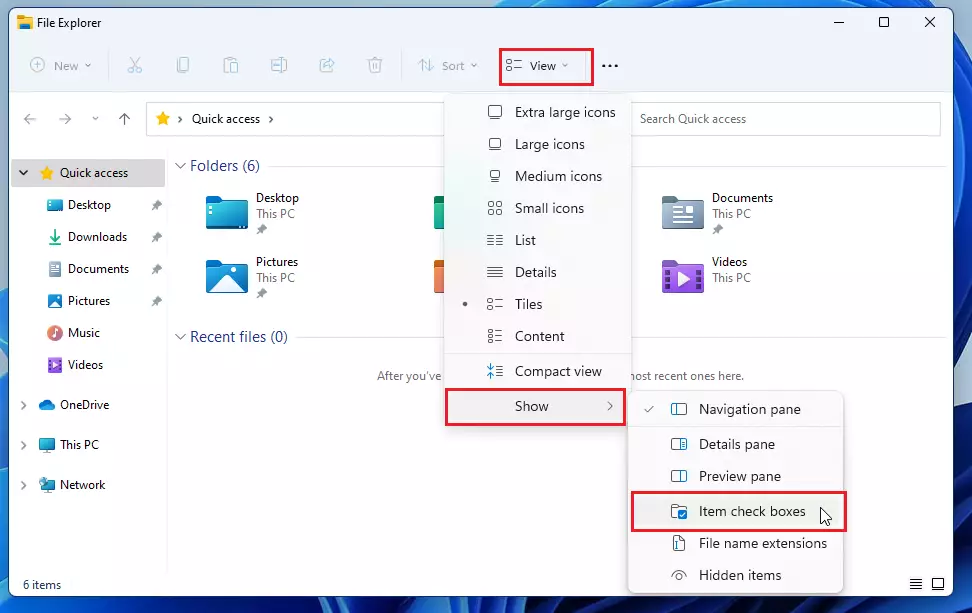
Open File Explorer , click View in the top toolbar, hover over Show, and select Item check boxes. A tick appears in the menu and a small box appears beside every file and folder straight away. No restart or admin rights are needed, and the setting works on Home and Pro editions of Windows 11.
How to enable checkboxes in File Explorer
The quickest way is the View menu in any File Explorer window. Open a folder, click View in the top toolbar, point to Show, and select Item check boxes. A small box now appears next to each file and folder, so you can pick several items with the mouse alone.
The steps below go through it one at a time and say what you should see after each one.
- Open File Explorer . Press the Win plus E, or click the folder icon on the taskbar . A window opens showing Home or the last folder you used.
- Click the View button in the top toolbar. A dropdown menu opens with layout and display options.
- Hover over Show at the bottom of the dropdown menu. A second menu slides out to the side with a list of display options.
- Click Item check boxes to select it. A tick appears next to the option, and the menu closes.
In short: open File Explorer , click View in the top toolbar, hover over Show, and select Item check boxes.
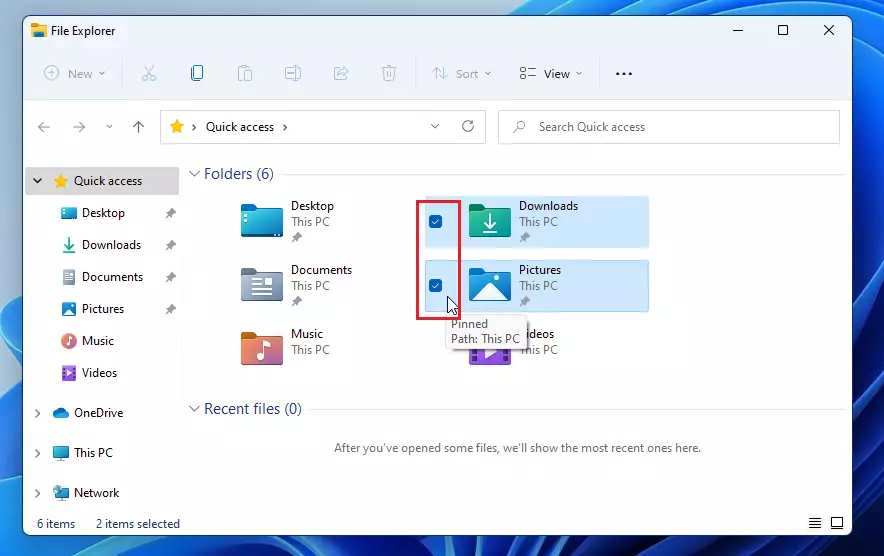
You see the boxes right away. Hover over a file or folder and a small empty box appears at its left edge. Click the box to select the item and it fills with a tick. You can tick as many boxes as you like, and the selection stays until you untick them or click elsewhere.
If you use the Details view, a box also appears in the header row of the file list. Click it to select every item in the folder, and click it again to clear them all. No admin privileges are needed, because the setting applies to your own user account only.
Once items are selected, the toolbar buttons for copy, cut, rename, share and delete work on the whole group. The Ctrl key and the Ctrl+A shortcut still work as before, so the checkboxes do not replace them.
How to disable checkboxes
If the boxes get in the way, you can hide them again. Repeat the same steps you used to turn them on:
- Open File Explorer and click View in the top toolbar.
- Hover over Show.
- Click Item check boxes to remove the tick.
The checkboxes disappear from the file view straight away. Any files you had ticked may stay selected for a moment. Click an empty area of the folder to clear the selection.
Troubleshooting persistent checkboxes
Sometimes the checkboxes stay visible after you turn them off, or the menu setting does not seem to take effect. File Explorer may simply need a refresh. Restarting the Windows Explorer process usually fixes it:
- Press Ctrl+Shift+Esc to open Task Manager .
- On the Processes tab, find Windows Explorer in the list. If you see a short view of Task Manager , click More details first.
- Right-click Windows Explorer and select Restart.
That is normal. Open File Explorer again and check the View Show menu. Save any open work first, although restarting Explorer does not close your other apps.
Advanced Fix: Using the Registry Editor
If the standard menu option does not work, you can force the setting through the Registry Editor. The registry is a database that stores low-level Windows settings . This method changes one value in it directly.
A wrong change in the registry can cause system problems, so follow the path exactly and edit only the value described here. If you want a safety net, create a restore point or export the registry key before you change anything.
The checkbox setting in the Registry Editor is a value named AutoCheckSelect. Locate it and change its value data to 1 to turn the checkboxes on, or to 0 to turn them off. The value belongs to your own user account, so you do not need to change anything for other users.
Restart the computer so the change takes effect. Signing out and back in, or restarting the Windows Explorer process as described above, can also work. To undo the change, set the value back to what it was.
Tablet Mode vs. Desktop Mode
Windows 11 adjusts parts of its interface for touch devices. On a tablet or a 2-in-1 laptop, you may find checkboxes already on, because they make selecting files with a finger much easier. Windows 11 does not have the separate Tablet Mode switch that Windows 10 had, so the behavior depends on your device and how you are using it.
If you later move to a desktop setup with a mouse and keyboard, you may prefer to turn the checkboxes off to save screen space. Use the View Show Item check boxes option the same way as on any other PC.
Summary
Item checkboxes make file management faster in Windows 11 File Explorer, whether you use a mouse or a touchscreen. Turning them on or off takes a few seconds in the View menu, and you can change your mind at any time. If the menu ever fails, the Task Manager restart and the registry value are your fallbacks.
Have a question about this guide?
Answered by AI from this guide. Good questions may be added to this page — please don't include personal details.
Did this guide fix your problem?

About the Author
Richard
Tech Writer, IT Professional
Richard is a writer at Geek Rewind who turns complex IT tasks into clear, step-by-step guides. He draws on years of hands-on experience in system administration and enterprise IT operations, focusing on Windows, Linux and WordPress: the problems people actually run into, and the fixes that work. His server and WordPress guides come from systems he runs himself. Richard builds and maintains the platform behind Geek Rewind, from its Ubuntu servers and Nginx configuration to its custom WordPress plugins. Many new tutorials start with readers' questions, and he's always glad to answer them in the comments.
No comments yet — be the first to share your thoughts!