How to Reset Windows Terminal to Default Settings in Windows 11

Resetting Windows Terminal in Windows 11 clears out custom tweaks and puts the app back to its original state. Windows Terminal is a free tool that brings Command Prompt, PowerShell, and Linux tabs together into one window. It is the default terminal app on current Windows 11 builds, and you can also install it from the Microsoft Store.
Most problems start inside the settings .json file found at 📂%LocalAppData%\
Before you reset, copy settings.json somewhere safe if you might want your old setup back. A reset made through the Settings app cannot be undone, so the copy is your only way back. This guide covers three methods. Pick one; you do not need all three.
Open Settings , click Apps, then Installed apps. Find Terminal, click the three dots, and select Advanced options. Click the Reset button to restore default settings. Alternatively, delete the settings .json file via Command Prompt, PowerShell, or File Explorer .
Method 1Use the Settings App
You can reset Windows Terminal from the built-in Settings app on Windows 11. This method suits you if you prefer menus to command-line tools. It works the same on Home and Pro. It also removes the app’s data, so close any open Terminal windows first.
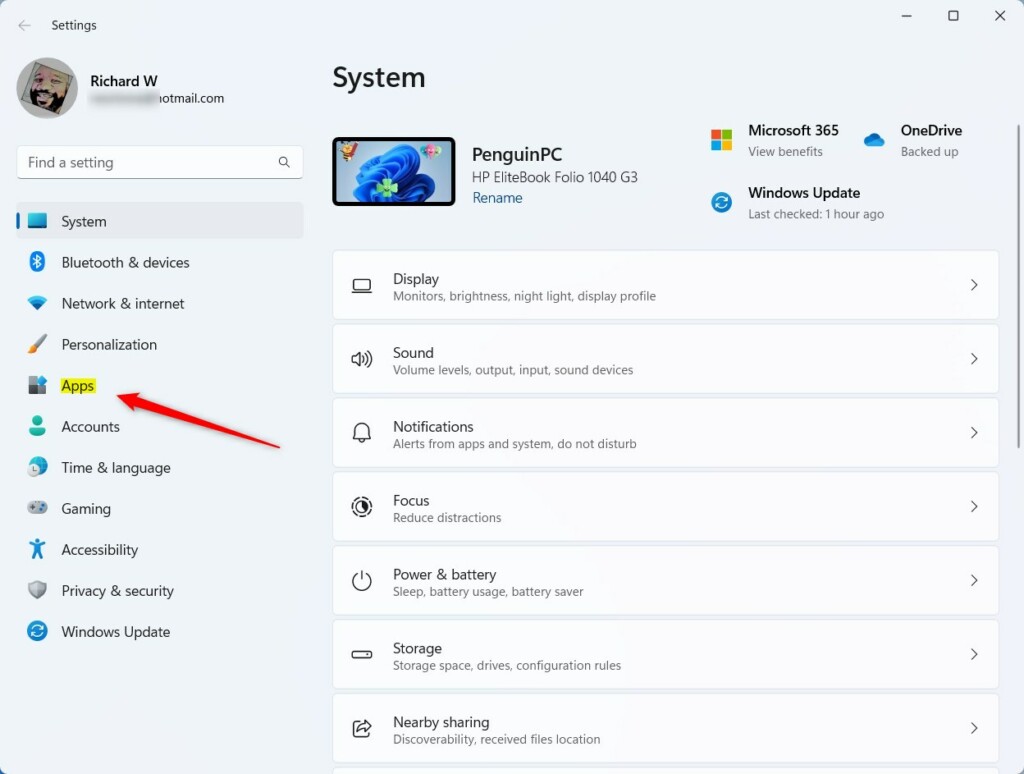
- Open Settings . The quickest way is to press Win+I.
- Click Apps in the left pane.
The Apps page should now be showing on the right.
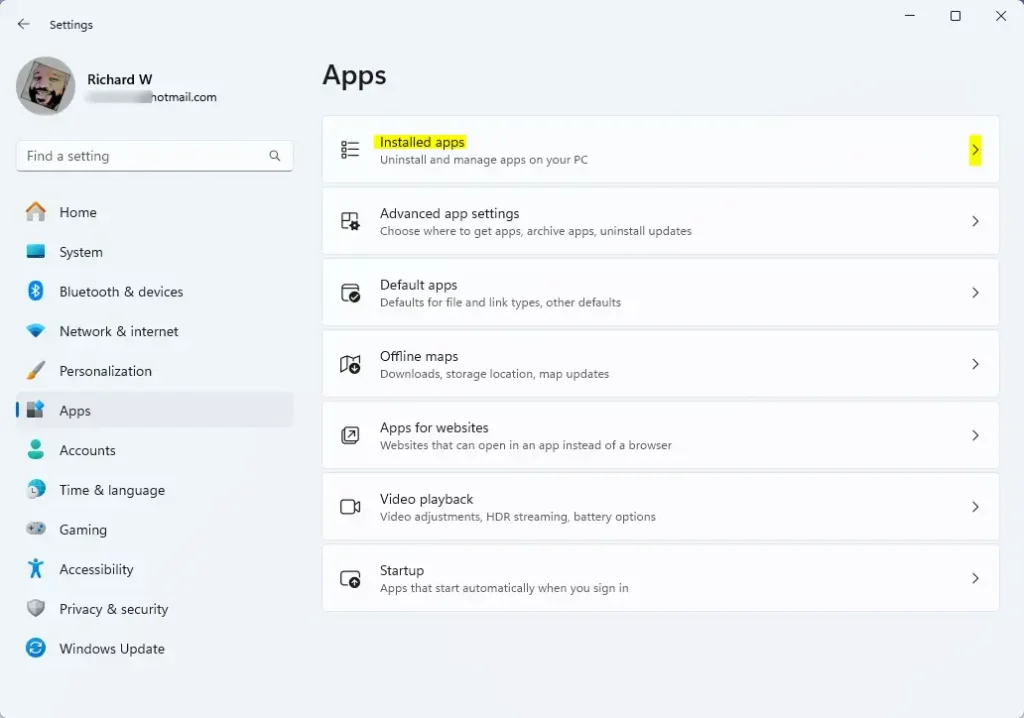
- On the right side, click Installed apps.
A list of every installed app appears. You can sort or search it to find what you need.
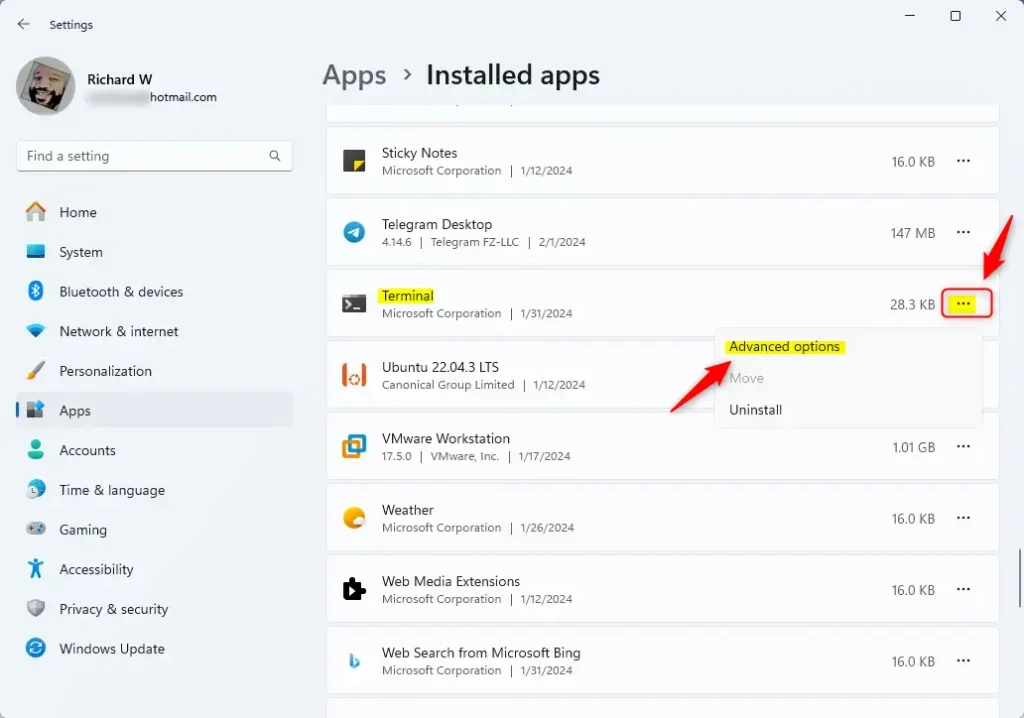
- Find Windows Terminal in the list. Type "terminal" in the search box above the list if you do not see it right away. On some builds it is listed simply as Terminal.
- Click the three dots next to it.
- Select Advanced options from the dropdown menu.
The Windows Terminal settings page should open. If Advanced options is missing, you are probably looking at a different entry, such as a classic console shortcut. Make sure you picked the Store app.
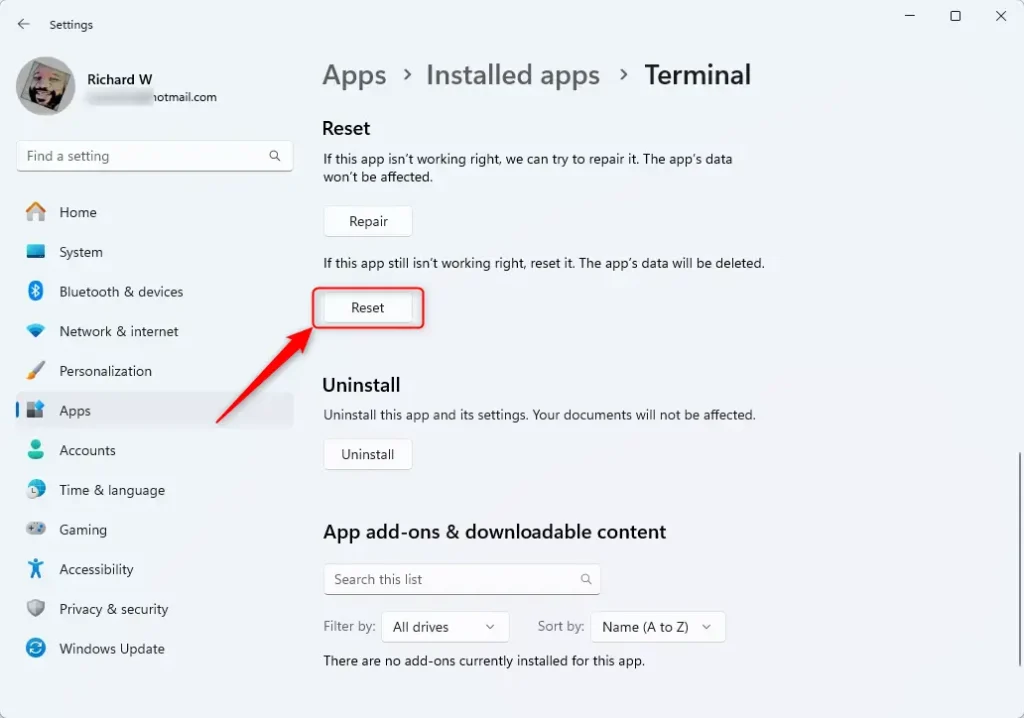
- Scroll down to the Reset section on the Windows Terminal settings page.
- Click the Reset button. If a confirmation message appears, click Reset again.
This restores all default settings and undoes your previous customizations, including profiles, color schemes, and key bindings. Windows shows a check mark next to the button when it finishes. The page also offers a Repair button. Repair tries to fix the app without touching its data, so use it first if the app misbehaves but you want to keep your settings.
- Close the Settings app.
Open Windows Terminal to check. It should start with the default profiles and theme.
Method 2Use Command Prompt or PowerShell
You can reset Windows Terminal quickly by running a single command in Command Prompt or PowerShell. The command deletes the configuration file for you, so you do not need to click through any menus. Run it as an administrator, as shown below. Close Windows Terminal first so the file is not in use, and copy settings.json elsewhere if you want a backup.
Using Command Prompt:
- Open Command Prompt as an administrator. Search for Command Prompt in the Start menu, then choose Run as administrator.
- Click Yes if User Account Control asks for permission.
- Run this command:
del /f /s /q /a "%LocalAppData%\Packages\Microsoft.WindowsTerminal_8wekyb3d8bbwe\LocalState\settings.json"
If the command succeeds, you are returned to the prompt without an error. Windows Terminal will use default settings the next time you start it.
Using PowerShell:
- Open PowerShell as an administrator. Search for PowerShell in the Start menu, then choose Run as administrator.
- Click Yes if User Account Control asks for permission.
- Run this command instead:
Remove-Item -Path "$env:LOCALAPPDATA\Packages\Microsoft.WindowsTerminal_8wekyb3d8bbwe\LocalState\settings.json" -Force
Use only one of the two commands. Both do the same job. To undo the reset, copy your backup of settings.json back into the LocalState folder.
Method 3Use File Explorer
You can also reset Windows Terminal by deleting the configuration file yourself in File Explorer. This method lets you see the settings folder and remove the file by hand. It is also the easiest way to keep a backup, because you can copy the file before you delete it.
- Close Windows Terminal.
- Open File Explorer. Press Windows key + E if you want a shortcut.
- Click the address bar at the top and type this path:
%LocalAppData%\Packages\Microsoft.WindowsTerminal_8wekyb3d8bbwe\LocalState
- Press Enter to go to that folder.
You should see the LocalState folder for Windows Terminal, which holds settings.json. If the folder does not exist, Windows Terminal is not installed from the Store. Terminal Preview uses a similar folder named Microsoft.WindowsTerminalPreview_8wekyb3d8bbwe.
- Find the file named settings.json. If you want a backup, copy it to your Desktop or another folder first.
- Right-click settings.json and select Delete. On Windows 11 this may be the trash can icon in the row of icons at the top of the menu.
The file disappears from the folder. It goes to the Recycle Bin, so you can restore it from there if you change your mind.
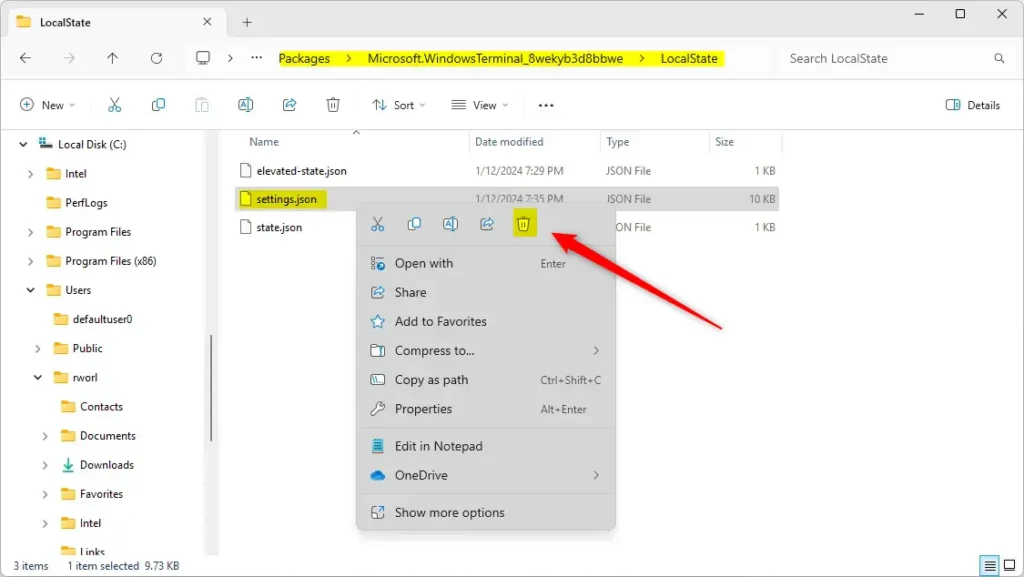
Windows Terminal is now reset to default. Open it again and it creates a new settings.json with default values. No restart of Windows is needed.
Summary
You can reset Windows Terminal using the Settings app, the command line, or File Explorer. The Settings app is the most thorough, because it clears all the app's data. The command line and File Explorer methods only remove settings.json, which is usually where the problem is. Whichever you choose, keep a copy of settings.json first if you might want your customizations back.
Was this guide helpful?

About the Author
Richard
Tech Writer, IT Professional
Richard is a writer at Geek Rewind who turns complex IT tasks into clear, step-by-step guides. He draws on years of hands-on experience in system administration and enterprise IT operations, focusing on Windows, Linux and WordPress: the problems people actually run into, and the fixes that work. His server and WordPress guides come from systems he runs himself. Richard builds and maintains the platform behind Geek Rewind, from its Ubuntu servers and Nginx configuration to its custom WordPress plugins. Many new tutorials start with readers' questions, and he's always glad to answer them in the comments.


No comments yet — be the first to share your thoughts!