How to install WordPress with Nginx on Ubuntu 24.04

You install WordPress with Nginx on Ubuntu 24.04 to build a fast and efficient website.
This process involves configuring Nginx, a high-performance web server, to serve your WordPress site. Nginx is renowned for its speed and ability to handle many simultaneous connections, making it a great choice for busy sites.
You’ll create a LEMP stack on Ubuntu 24.04, specifically optimizing it for WordPress. This setup allows you to take full advantage of Nginx’s features like advanced caching and SSL termination to enhance your website’s performance and security.
Install Nginx, MariaDB, and PHP-FPM using apt commands. Then create a WordPress database and user within MariaDB. Finally, configure Nginx to serve your WordPress site.
Install Nginx HTTP server on Ubuntu
To run WordPress, you need a web server, and we’ll use Nginx for this guide. Installing Nginx on Ubuntu is straightforward using the terminal; just run a couple of commands to get it set up and ready to go.
To do that, open the Ubuntu terminal and run the commands below to install the Nginx web server.
sudo apt update
sudo apt install nginx
Once Nginx is installed, the commands below can start, stop, and enable the Nginx web server to start automatically when your server boots up.
sudo systemctl stop nginx
sudo systemctl start nginx
sudo systemctl enable nginx
You can test the Nginx web server by opening your web browser and browsing to the server’s localhost or IP address.
http://localhost
When you see “Welcome to nginx!” the Nginx HTTP server has been installed.
Additional help on installing Nginx on Ubuntu is in the link below.
Install MariaDB database server on Ubuntu
WordPress needs a database to store all its information, and we’ll install MariaDB for this. You can install the MariaDB database server on Ubuntu easily by opening your terminal and running the update and install commands.
To install and use the MariaDB database server, use the instructions below.
Open the Ubuntu terminal and run the commands below to install the MariaDB database server.
sudo apt update
sudo apt install mariadb-server
Once the MariaDB database server is installed, use the commands below to stop, start, and enable the MariaDB server to start automatically when the server boots.
sudo systemctl stop mariadb
sudo systemctl start mariadb
sudo systemctl enable mariadb
Run the following commands to validate and test if the MariaDB database server is installed successfully.
sudo mariadb
Once you run the commands above, it will log you onto the MariaDB console and display a message similar to the one below.
Welcome to the MariaDB monitor.  Commands end with ; or g.
Your MariaDB connection id is 32
Server version: 10.11.2-MariaDB-1 Ubuntu 23.04

Copyright (c) 2000, 2018, Oracle, MariaDB Corporation Ab and others.

Type 'help;' or 'h' for help. Type 'c' to clear the current input statement.

MariaDB [(none)]>
The message tells you that the server is installed successfully.
Additional help on installing MariaDB.
- How to install MariaDB on Ubuntu Linux
- MariaDB without password prompt
Create a WordPress database
After installing MariaDB, you need to create a special database for WordPress to use. We’ll set up a database named ‘wordpressdb’ and a user called ‘wordpressdbuser’ to manage it, giving them full access.
As part of the setup, we will create a database named ‘wordpressdb ‘and a corresponding user account called ‘wordpressdbuser ‘.
Finally, we’ll grant the wordpressdbuser full access to the wordpressdb database.
All the database steps above can be done using the commands below:
But first, log on to the MariaDB database server:
sudo mariadb
Then run the commands below to complete the steps:
CREATE DATABASE wordpressdb CHARACTER SET utf8mb4 COLLATE utf8mb4_general_ci;
CREATE USER wordpressdbuser@localhost IDENTIFIED BY 'type_your_password_here';
GRANT ALL ON wordpressdb.* TO wordpressdbuser@localhost WITH GRANT OPTION;
FLUSH PRIVILEGES;
exit
Ensure to replace ‘type_your_password_here‘ with your password.
Install PHP-FPM on Ubuntu
PHP-FPM is the final piece needed to make WordPress work, as WordPress is built with PHP. Installing PHP-FPM and some common extensions on Ubuntu is done with a single command in your terminal.
Run the commands below to install PHP-FPM.
sudo apt install php-fpm php-intl php-mysql php-curl php-cli php-zip php-xml php-gd php-common php-mbstring php-xmlrpc php-json php-sqlite3 php-soap php-zip
Additional help on installing PHP
Download WordPress files
Now it’s time to get the WordPress files onto your Ubuntu server. You’ll download the latest WordPress package, unpack it, move the files to the correct Nginx folder, and then adjust permissions so Nginx can use them.
First, navigate to the /tmp/ directory and download WordPress files. After unzipping the file, move the content into the WordPress folder in the Nginx root directory.
The final step is to change the permissions. This will allow the Nginx web server to safely interact with the files, ensuring a secure environment for your WordPress installation.
cd /tmp/
wget https://wordpress.org/latest.tar.gz
tar -xvzf latest.tar.gz
sudo mv wordpress /var/www/wordpress
sudo chown -R www-data:www-data /var/www/wordpress/
Once you have completed all the above steps, continue below to configure the Nginx web server to serve the WordPress content.
Run the commands below to create a Nginx virtual host file for WordPress.
sudo nano /etc/nginx/sites-available/wordpress.conf
Then, copy and paste the content block below into the Nginx server block.
server {
    listen 80;
    listen [::]:80;
    root /var/www/wordpress;
    index  index.php;
    server_name  wordpress.example.com www.wordpress.example.com;

    location / {
        try_files $uri $uri/ /index.php?$args;
    }

    location ~ .php$ {
         include snippets/fastcgi-php.conf;
         fastcgi_pass unix:/var/run/php/php8.3-fpm.sock;
         fastcgi_param SCRIPT_FILENAME $document_root$fastcgi_script_name;
         include fastcgi_params;
    }
}
Save the file.
Then, run the commands below to enable the virtual host and restart the Nginx server.
sudo ln -s /etc/nginx/sites-available/wordpress.conf /etc/nginx/sites-enabled/
sudo systemctl restart nginx.service
Setup Let’s Encrypt SSL/TLS for WordPress
To keep your WordPress site secure, it’s a good idea to set up an SSL/TLS certificate using Let’s Encrypt. This process will allow your site to use HTTPS, making connections to it safe and private.
Please read the post below for additional resources on installing and creating Let’s Encrypt SSL certificates for Nginx.
How to set up Let’s Encrypt SSL certificate for Nginx on Ubuntu Linux
Once you have restarted the Nginx web server, open your browser and browse to the server hostname or IP address defined in the Nginx server block.
http://wordpress.example.com
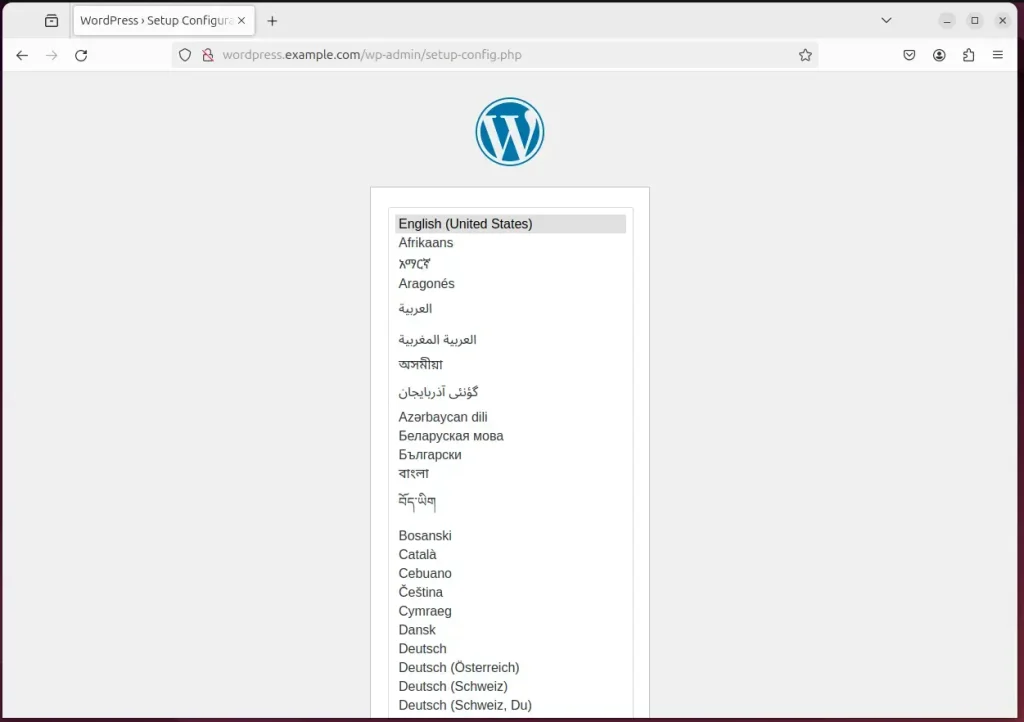
A WordPress installation wizard page should appear. Select the installation language and continue to the next page.
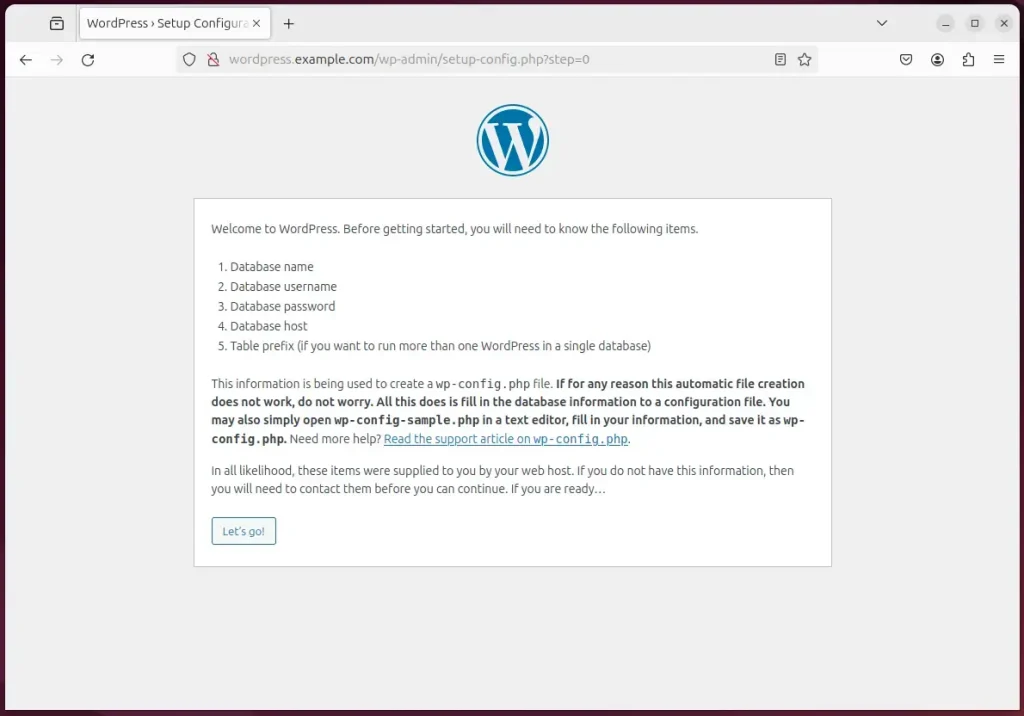
Next, click the Let’s go button to begin the installation process.
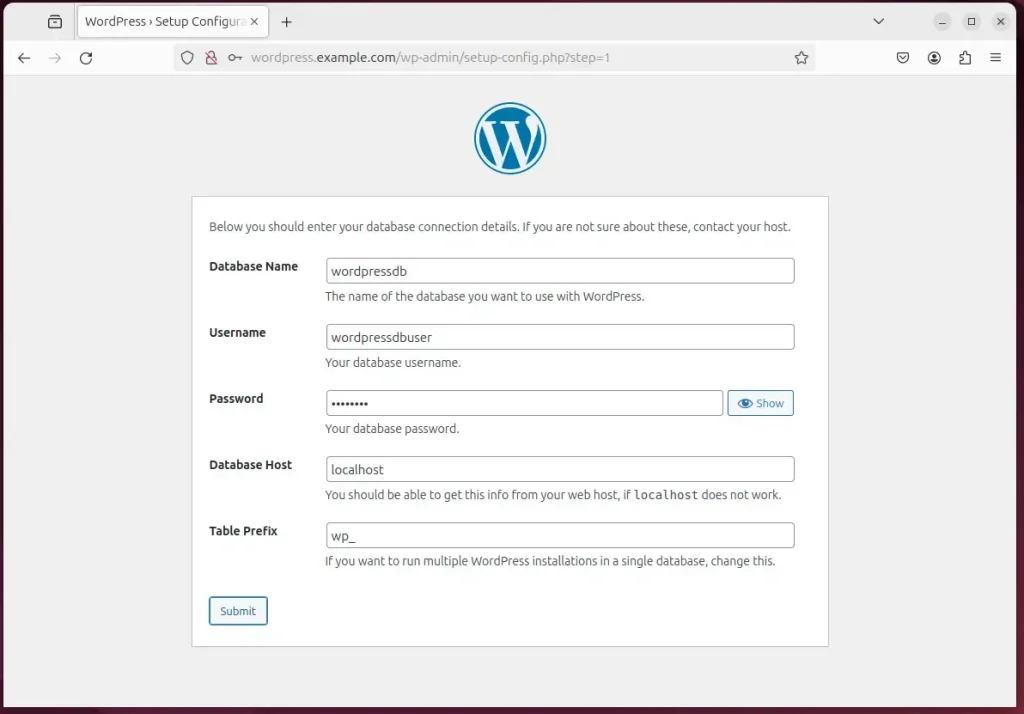
Type the database name, account name, and password on the next screen. Then, click Submit.
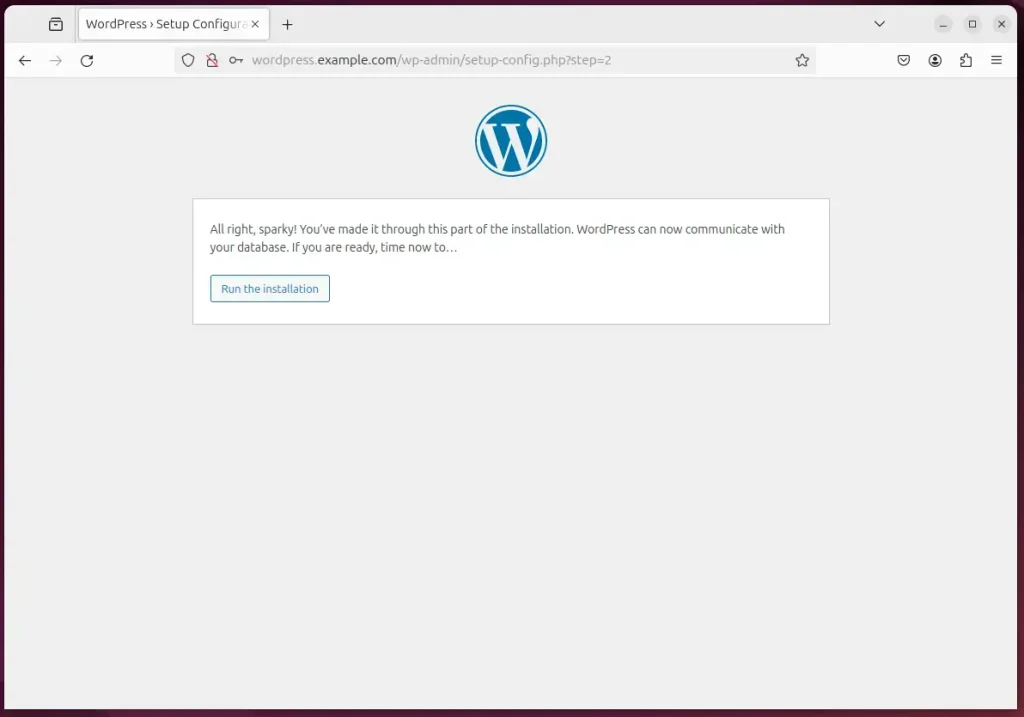
Next, click the “Run the installation” button to install WordPress files.
Next, type in the site title, admin account, email address, and password. Then, click “Install WordPress.”
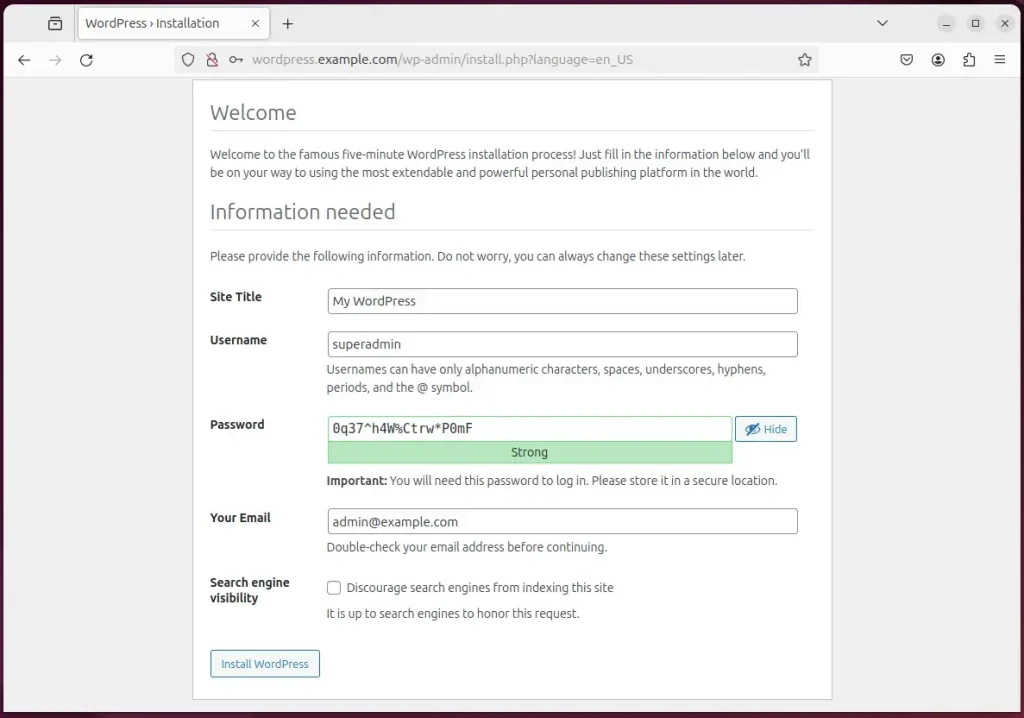
Your WordPress site should be set up and ready to use.
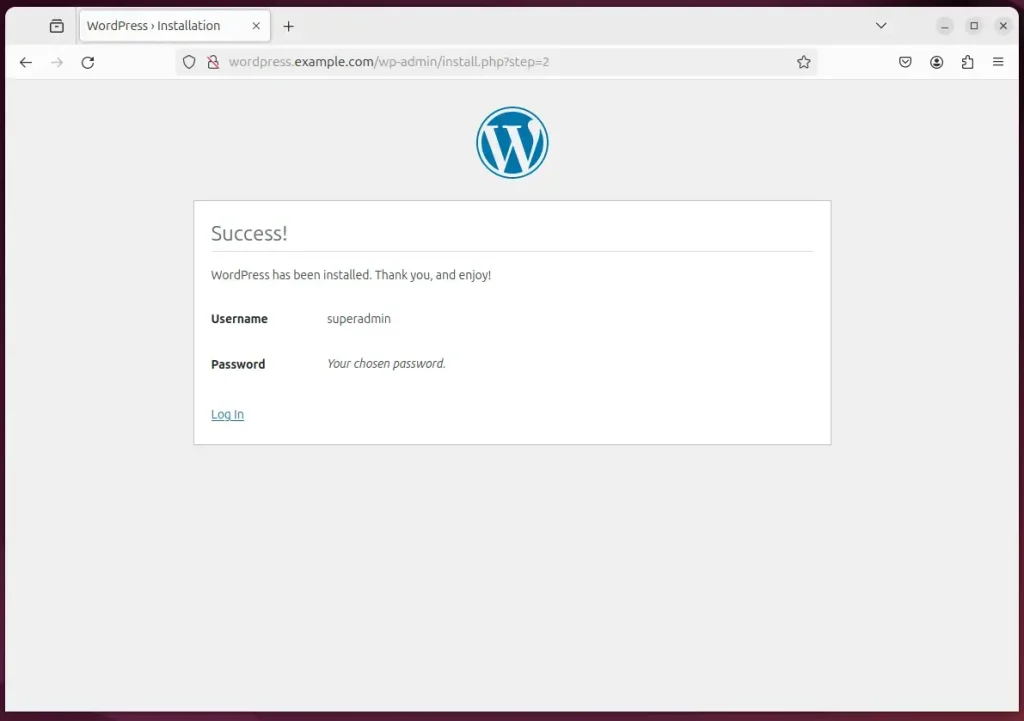
That should do it!
Conclusion:
- WordPress with Nginx support on Ubuntu 24.04 enhances website performance, scalability, and security.
- Nginx’s high performance, low memory usage, and customizable configuration make it an excellent choice for serving WordPress sites.
- Integrating Nginx with WordPress allows efficient management of tasks such as caching, load balancing, and SSL termination.
- The combination of Nginx, MariaDB, and PHP-FPM forms a reliable system for running WordPress on Ubuntu.
- Setting up Let’s Encrypt SSL/TLS certificates for Nginx further enhances the security of the WordPress installation.
This comprehensive guide offers a step-by-step approach to setting up WordPress with Nginx support on Ubuntu, ensuring a robust and secure foundation for your website.
Can you install nginx on Ubuntu?
Nginx is available in Ubuntu's default repositories. Install it using the apt packaging system.
Can WordPress run on Nginx?
While the LAMP stack (Linux + Apache + MySQL + PHP) is very popular for powering WordPress, it is also possible to use Nginx. WordPress supports Nginx, and some large WordPress sites, such as WordPress.com, are powered by Nginx.
Was this guide helpful?

About the Author
Richard
Tech Writer, IT Professional
Richard, a writer for Geek Rewind, is a tech enthusiast who loves breaking down complex IT topics into simple, easy-to-understand ideas. With years of hands-on experience in system administration and enterprise IT operations, he’s developed a knack for offering practical tips and solutions. Richard aims to make technology more accessible and actionable. He's deeply committed to the Geek Rewind community, always ready to answer questions and engage in discussions.




No comments yet — be the first to share your thoughts!