How to Delete Recall Snapshots in Windows 11

To delete Recall snapshots in Windows 11, you’ll go to Storage settings and manage the Recall data.
Recall is a new Windows 11 feature that continuously takes screenshots, creating snapshots of your activity so you can easily revisit past screens and information. These snapshots are stored locally on your PC.
Over time, these snapshots can take up a lot of disk space, especially if you use Recall a lot. A single day of heavy use might even create gigabytes of snapshot data.
To reclaim storage, you can manually delete these snapshots. This process allows you to clear out stored data from specific timeframes or remove it all.
Access Storage settings within Privacy & Security to manage Recall data. Click “Delete snapshots” and choose a timeframe like the past hour, day, week, or month to remove them. Confirm the deletion to free up disk space.
What are Recall Snapshots?
Recall Snapshots are like automatic pictures your computer takes of your screen, helping you find things you’ve seen before.
Think of Recall Snapshots as photos your computer takes of your screen at different times. Windows saves these so you can easily search for things you’ve seen or worked on previously. You can find more details about this feature in the Recall & Snapshots explained documentation. While Windows automatically deletes the oldest snapshots when your storage is full, you might want to clear some out yourself. Here’s how you can delete snapshots from the last hour, day, week, or month.
Steps to Delete Recall Snapshots from a Specific Timeframe
You can delete recall snapshots from a specific time, like the last hour, day, or week, to free up storage space on your computer.
- Open the Settings app: You can do this by clicking the Start menu (Windows icon at the bottom left) and choosing Settings, or just press Windows key + I on your keyboard.
- Go to Privacy & Security: In the Settings window, look at the left side menu and click Privacy & security.
- Open Recall & Snapshots settings: On the right side, find and click Recall & snapshots.
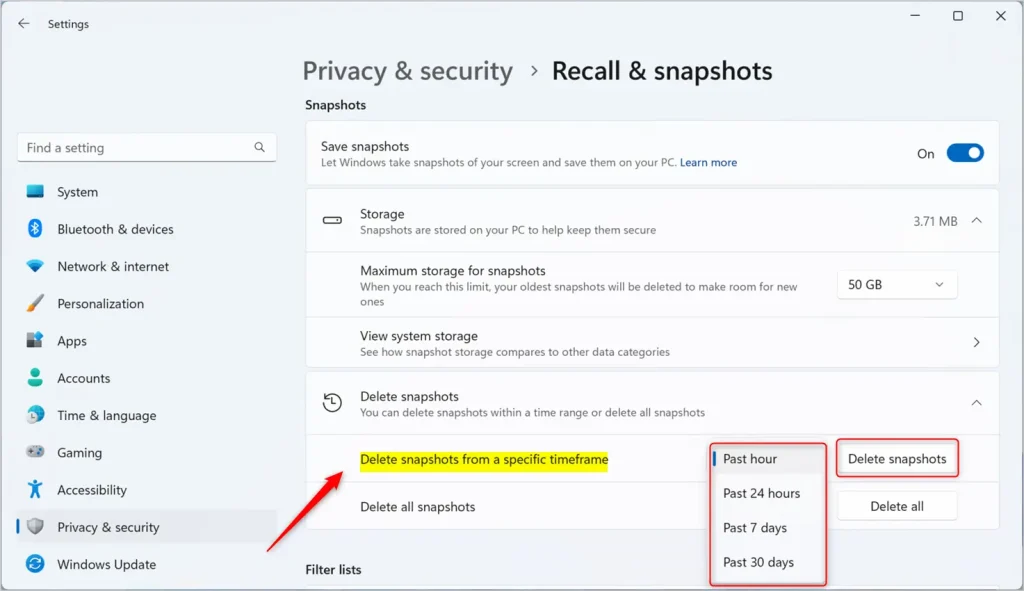
- Delete snapshots: Scroll down to the Storage section and click Del snapshots to expand it.
- Choose a timeframe: Click on Delete snapshots from a specific timeframe. You can pick from these options:
- Past hour
- Past 24 hours
- Past 7 days
- Past 30 days
- Confirm deletion: Click the Delete snapshots button after choosing the timeframe. The snapshots from that period will be removed.
Here is what the Privacy & Security menu looks like in Windows 11:
And this is the screen where you delete snapshots from a specific timeframe:
That’s it! You have now deleted Recall snapshots for the timeframe you selected.
Need More Help?
You can visit Microsoft’s official page about Recall and your data here: Microsoft Support – Recall and Your Data
Summary
- Recall Snapshots save pictures of your screen to help you find things later.
- You can delete snapshots from the last hour, day, week, or month to free up space.
- It’s easy to manage this in the Windows 11 Settings under Privacy & Security.
- Following these steps helps keep your computer storage under control.
Managing your Recall Snapshots is simple and helps keep your computer running smoothly by freeing up space.
How do I delete Microsoft recall screenshots?
Deleting Microsoft Recall screenshots is easy and can be done anytime through your PC’s Settings menu under Privacy & security.
Is disabling Recall good?
Disabling Recall gives users and administrators control over what's being captured and stored, ensuring transparency and better system performance.
Was this guide helpful?

About the Author
Richard
Tech Writer, IT Professional
Richard, a writer for Geek Rewind, is a tech enthusiast who loves breaking down complex IT topics into simple, easy-to-understand ideas. With years of hands-on experience in system administration and enterprise IT operations, he’s developed a knack for offering practical tips and solutions. Richard aims to make technology more accessible and actionable. He's deeply committed to the Geek Rewind community, always ready to answer questions and engage in discussions.

No comments yet — be the first to share your thoughts!