How to Change BitLocker Encryption in Windows 11

You can change BitLocker encryption in Windows 11 to a stronger algorithm, like moving from the default XTS-AES 128-bit to XTS-AES 256-bit, for enhanced data security.
BitLocker is a critical Windows feature that encrypts entire drives, safeguarding your data from unauthorized access. This encryption ensures only you or authorized individuals can read files on protected drives.
You can implement BitLocker on your operating system drive, internal storage, and removable media. While Windows 11 defaults to XTS-AES 128-bit, upgrading to XTS-AES 256-bit provides significantly higher security for your sensitive information.
Change BitLocker encryption by opening Local Group Policy Editor and navigating to Computer Configuration > Administrative Templates > Windows Components > BitLocker Drive Encryption. Double-click “Choose drive encryption method and cipher strength” to select your desired algorithm and key strength, then restart your computer.
Why Change Your BitLocker Settings?
A stronger encryption code makes your data harder for others to crack. If you work with very sensitive information, using 256-bit encryption gives you extra protection.
What Happens When You Change These Settings?
When you change these settings, your files remain protected with the new, stronger encryption. Any new files you create will immediately use the updated settings. Keep in mind that your computer might need to restart for these changes to take effect.
Method 1Use Group Policy Editor
You can change your BitLocker encryption settings in Windows 11 using the Group Policy Editor, which lets you control how your drives are protected.
- Open the Local Group Policy Editor. Search for “Edit group policy” on your Start menu.
- Follow these folders in order:
- Computer Configuration
- Administrative Templates
- Windows Components
- BitLocker Drive Encryption
- On the right side, find “Choose drive encryption method and cipher strength (Windows 10 (Version 1511) and later)”. Double-click it.
- A window opens. You have three choices:
- Not Configured (this is the default) – BitLocker uses its standard settings
- Enabled – you pick the encryption type yourself
- Disabled – BitLocker uses AES with 128-bit or 256-bit strength
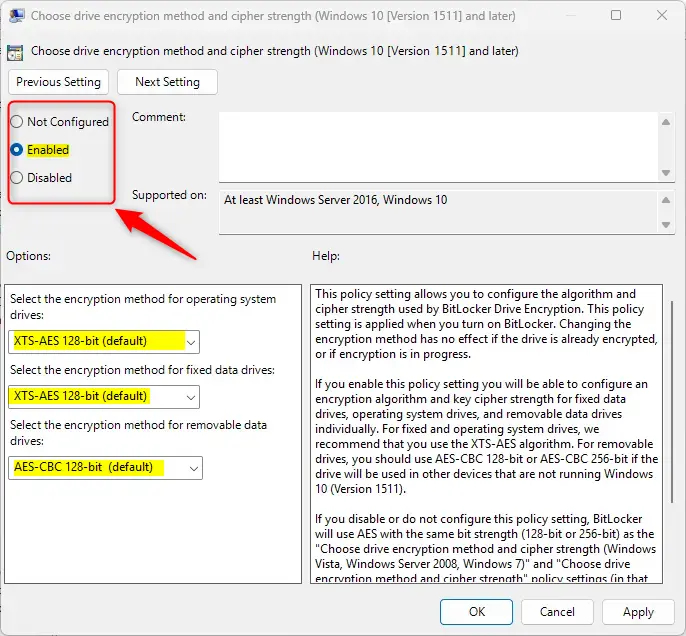
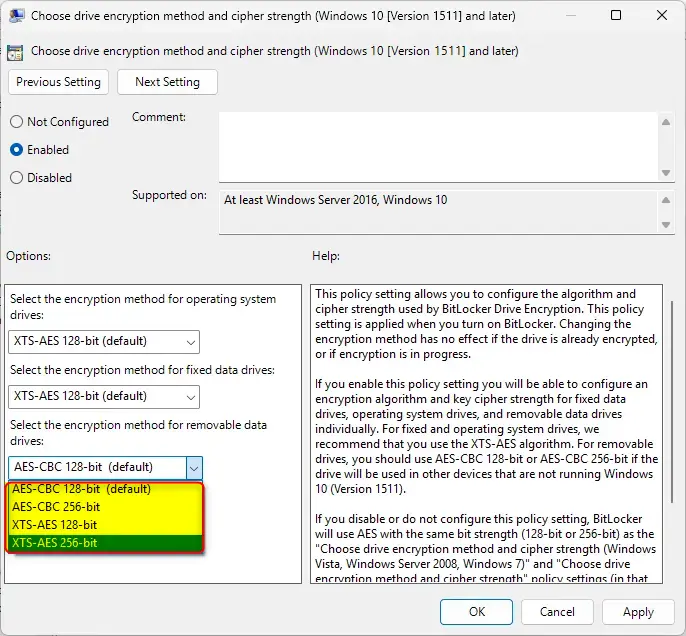
- If you pick Enabled, use the dropdown menu under Options. Choose your encryption method for:
- Operating system drives (your main drive)
- Fixed data drives (regular storage)
- Removable data drives (USB sticks)
- Click OK to save. You may need to restart your computer.
Method 2Use Registry Editor
If you’re comfortable making advanced changes, you can change your BitLocker encryption in Windows 11 by using the Registry Editor.
The Registry Editor is where Windows stores all its settings. Changing the wrong thing can cause problems. Be careful with this method.
- Open the Windows Registry Editor. Search for “regedit” on your Start menu.
- Look at the right side. You should see three items with these names:
EncryptionMethodWithXtsOsEncryptionMethodWithXtsFdvEncryptionMethodWithXtsRdv
- Double-click each one and change its value:
- Enter
4to useAES-CBC 256-bitencryption - Enter
7to useXTS-AES 256-bitencryption
- Enter
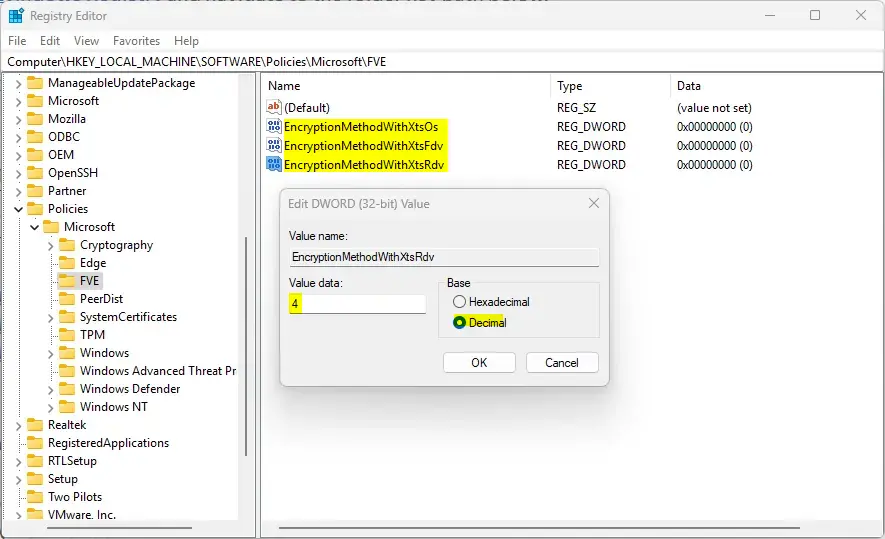
- Don’t see these items? Right-click a blank area on the right side. Pick “New” and then “DWORD (32-bit) Value”. Create all three items if they’re missing, then enter the values above.
- To go back to the default
XTS-AES 128-bitencryption, delete all three items you created or changed. - Save your changes and restart your computer.
Summary
Changing your BitLocker encryption in Windows 11 can make your data more secure, and you have two main ways to do it: the Group Policy Editor or the Registry Editor.
You have two ways to change this:
- Group Policy Editor – easier and safer for most people
- Registry Editor – more advanced, requires admin access
You can change encryption for your main drive, storage drives, and removable drives. Always restart your computer after making changes. This lets Windows use the new encryption settings.
Stronger encryption takes a bit more computer power but keeps your data much safer.
Was this guide helpful?

About the Author
Richard
Tech Writer, IT Professional
Richard, a writer for Geek Rewind, is a tech enthusiast who loves breaking down complex IT topics into simple, easy-to-understand ideas. With years of hands-on experience in system administration and enterprise IT operations, he’s developed a knack for offering practical tips and solutions. Richard aims to make technology more accessible and actionable. He's deeply committed to the Geek Rewind community, always ready to answer questions and engage in discussions.



No comments yet — be the first to share your thoughts!