How to Enable Quick Accent in Microsoft PowerToys

To turn on Quick Accent in Microsoft PowerToys, open PowerToys Settings, select Quick Accent in the left sidebar, and switch on Enable Quick Accent. It is a free tool in PowerToys version 0.60 and newer that lets you type accented letters like é, à, or ü without memorizing long keyboard codes. Press and hold a letter key and a small menu of special characters opens.
This saves you from switching your whole keyboard layout or copying and pasting symbols when you write in languages like French, Spanish, or German. It works on Windows 10 and Windows 11, and the steps below cover turning it on, using it, changing its settings and fixing it when the menu doesn’t appear.
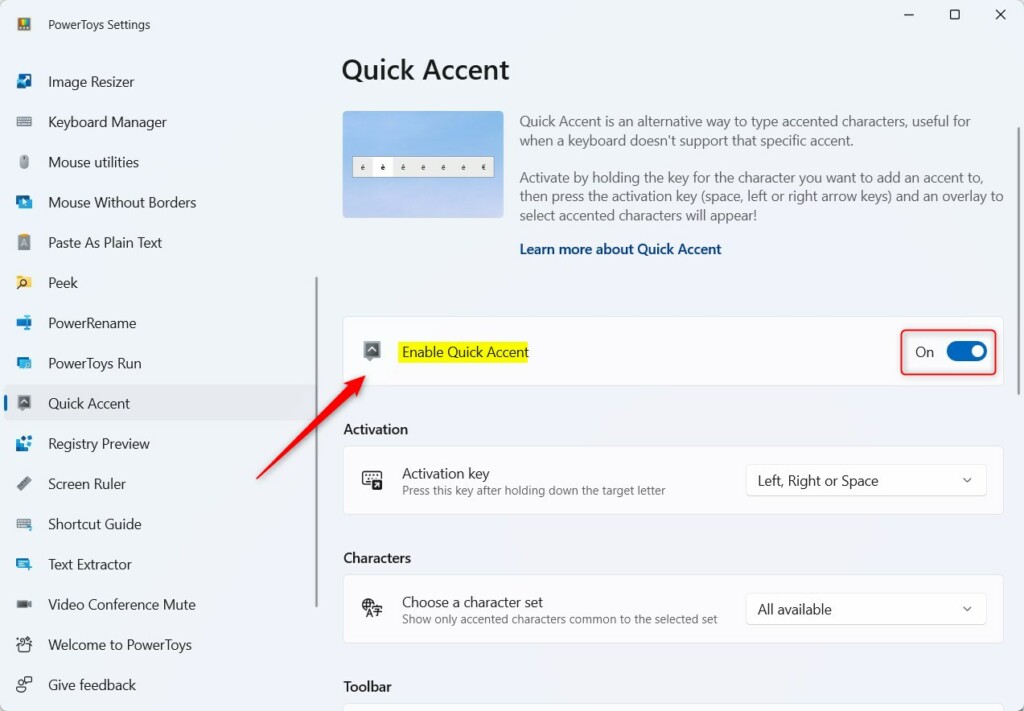
Open PowerToys settings, navigate to Quick Accent, and toggle the “Enable Quick Accent” switch to On. This allows you to hold a letter key to bring up a menu of accented characters.
Why use Quick Accent?
If you write in more than one language, you need diacritics (accent marks) often. The usual fix is to add an international keyboard layout, and then you have to learn where every key moved. Quick Accent skips that. Your normal layout stays as it is, and the character menu only appears when you hold a letter key.
Getting Started
Before you can use Quick Accent, you need the Microsoft PowerToys app installed on your Windows PC, and you need administrator privileges. Quick Accent is part of PowerToys, so there is nothing separate to download. If PowerToys is already installed, make sure it is version 0.60 or newer, because older builds don’t include the feature.
Once PowerToys is installed, open its settings window and look at the sidebar on the left. Quick Accent is listed there with the other utilities. If you can’t find it, update PowerToys first.
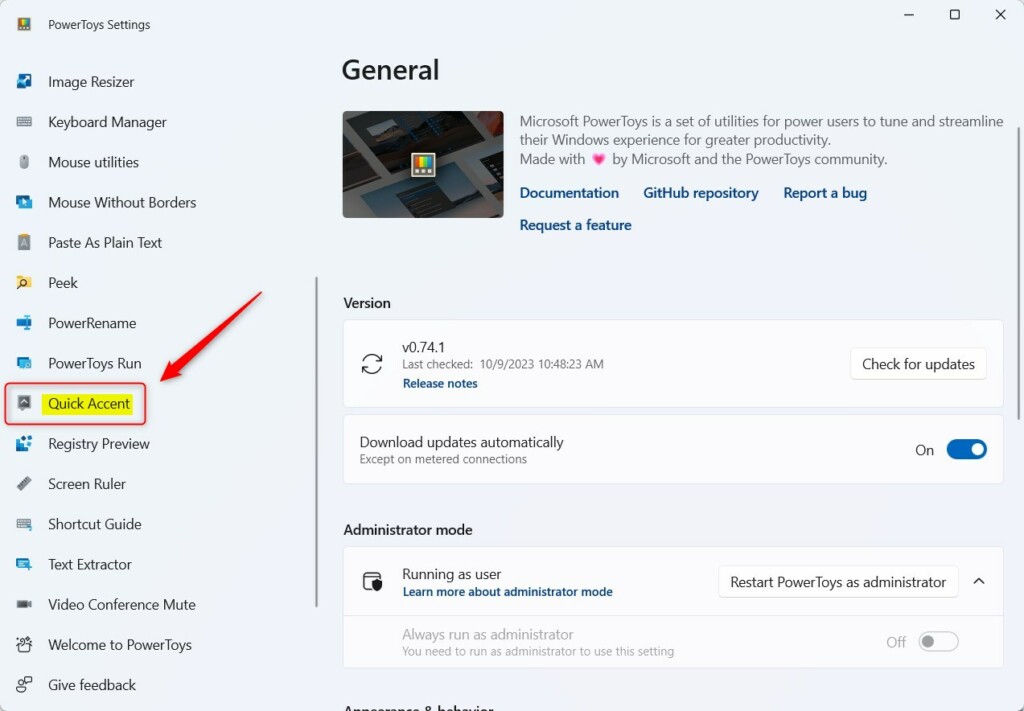
- Open the PowerToys settings app . You can find it in the Start menu or by right-clicking the PowerToys icon in the system tray .
- Select Quick Accent in the sidebar. The Quick Accent page opens on the right.
- Toggle the Enable Quick Accent switch to On. The feature is active right away, and you don’t need to restart Windows.
If the switch is greyed out or missing, check that PowerToys is fully installed and up to date. Your organization may also manage PowerToys settings by policy, and in that case you will need your administrator to change it.
To turn the feature off, go back to the same page in PowerToys settings and flip the same switch to Off. Do this whenever you no longer need it. Holding a key will then go back to normal behavior. If you only need to stop it in one program, use the excluded apps list covered in the troubleshooting section instead.
Customization and Settings
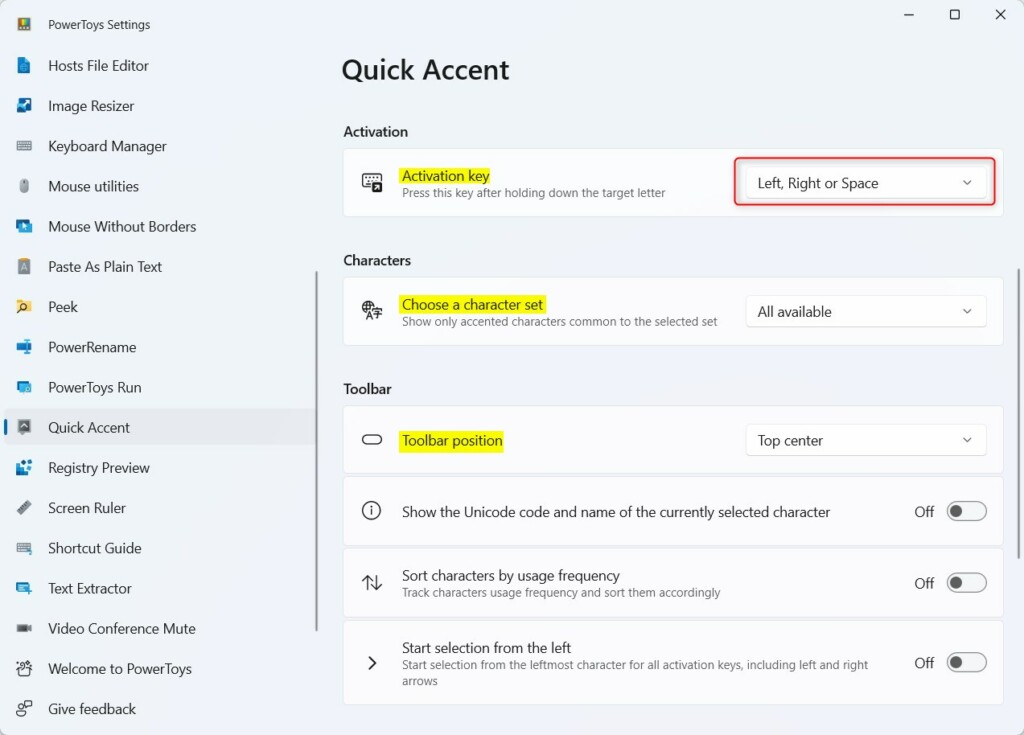
Everyone types a little differently, so Quick Accent has settings you can adjust. Open them from the Quick Accent page in PowerToys settings. There you can change the activation delay, which is how long you hold a key before the menu appears, and where the popup shows on your screen.
If the menu pops up when you only meant to hold a key for a moment, raise the delay. If it feels slow, lower it. Change one setting at a time and test it in a text editor so you know which change helped.
How to Use It
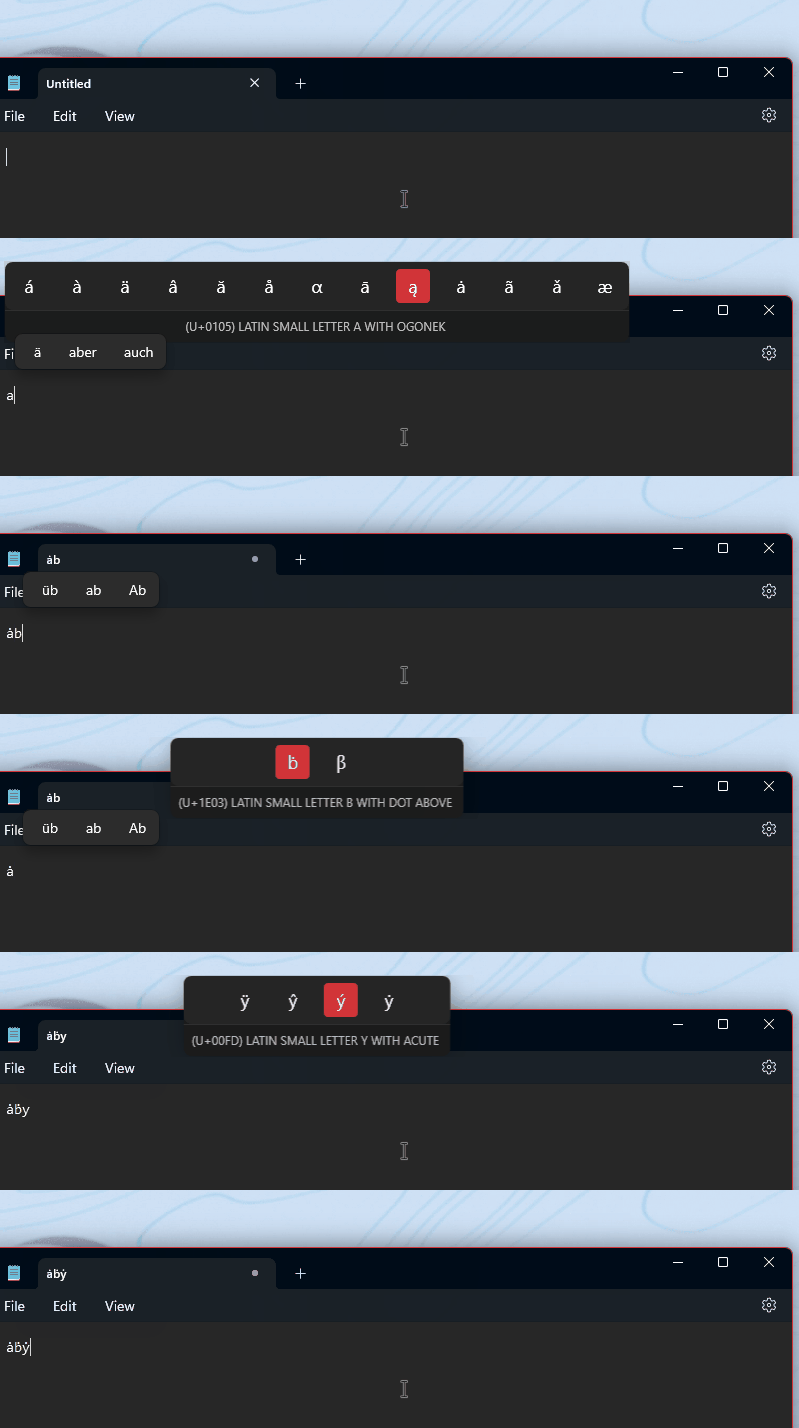
Quick Accent works by holding the base letter key until a small toolbar pops up on your screen. While you keep holding that key, tap the Space bar or the Left and Right arrow keys to move through the available accent marks. Release the letter key to type the character you picked.
Try it in Notepad first. Hold the e key, tap Space, and watch the highlight move along the bar.
- Hold down the key for the letter you want to type.
- While holding that key, press the Space bar or the Left/Right arrow keys.
- A small bar will appear on your screen showing different versions of that letter. The one that is currently selected is highlighted.
- Keep holding the letter key while you press Space or the arrow keys until the character you need is selected, then release the letter key to type it.
Common Keyboard Shortcuts
| Action | Method |
|---|---|
| Default Activation | Hold key + Space |
| Navigation | Left/Right Arrow keys |
| Selection | Release key or press Space |
Troubleshooting and Known Issues
If the menu doesn't appear, work through these checks in order:
- Look in the system tray and confirm PowerToys is running in the background. If it isn't, start it from the Start menu.
- Open PowerToys settings and make sure Enable Quick Accent is still set to On.
- Launch PowerToys with administrator privileges. Quick Accent can fail in programs that run with higher rights than PowerToys does.
- Review the Excluded apps list on the Quick Accent page. If the program you're typing in is on it, remove it, or you will keep getting normal key behavior there.
- Test in a simple app like Notepad. If it works there, the problem is the other program, not Quick Accent.
Summary
Quick Accent gives you international characters on demand, so you don't need a second keyboard layout or a character map. Once it becomes habit, writing documents and messages in several languages gets quicker, and your regular keyboard stays untouched.
Have a question about this guide?
Answered by AI from this guide. Good questions may be added to this page — please don't include personal details.
Did this guide fix your problem?

About the Author
Richard
Tech Writer, IT Professional
Richard is a writer at Geek Rewind who turns complex IT tasks into clear, step-by-step guides. He draws on years of hands-on experience in system administration and enterprise IT operations, focusing on Windows, Linux and WordPress: the problems people actually run into, and the fixes that work. His server and WordPress guides come from systems he runs himself. Richard builds and maintains the platform behind Geek Rewind, from its Ubuntu servers and Nginx configuration to its custom WordPress plugins. Many new tutorials start with readers' questions, and he's always glad to answer them in the comments.
No comments yet — be the first to share your thoughts!