How to Install Mantis Bug Tracker on Ubuntu with Apache

You install Mantis Bug Tracker on Ubuntu 24.04 with Apache to create a robust, self-hosted bug tracking system for your software projects.
Mantis Bug Tracker is an open-source, web-based system that helps development teams manage issues, tasks, and feature requests. It provides a centralized platform for reporting, tracking, and resolving bugs efficiently.
By integrating Mantis with the Apache web server on Ubuntu, you set up a reliable hosting solution. This guide shows you how to achieve this integration.
Install Apache, MariaDB, and PHP using apt commands. Create a Mantis database and user in MariaDB. Download Mantis and extract it to your Apache web root.
Install Apache HTTP server on Ubuntu
Installing the Apache web server on Ubuntu is the first step to running Mantis Bug Tracker, as it handles requests from users’ browsers.
To do that, open the Ubuntu terminal and run the commands below to install the Apache web server.
sudo apt update
sudo apt install apache2
Once Apache is installed, the commands below can start, stop, and enable the Apache web server to start automatically when your server boots up.
sudo systemctl stop apache2
sudo systemctl start apache2
sudo systemctl enable apache2
You can test that the Apache web server is running by opening your web browser and browsing to the server’s local host or IP address.
http://localhost
When you see the Apache2 Default Page, it means the Apache HTTP server is successfully installed.
Additional help on installing Apache on Ubuntu is in the link below.
Install the MariaDB database server on Ubuntu
Mantis Bug Tracker needs a database to store all its information, so we’ll install the MariaDB database server on your Ubuntu system.
To install and use the MariaDB database server, use the instructions below.
Open the Ubuntu terminal and run the commands below to install the MariaDB database server.
sudo apt update
sudo apt install mariadb-server
Once the MariaDB database server is installed, use the commands below to stop, start, and enable the MariaDB server to start automatically when the server boots.
sudo systemctl stop mariadb
sudo systemctl start mariadb
sudo systemctl enable mariadb
Run the following commands to validate and test if the MariaDB database server is installed successfully.
sudo mariadb
Once you run the commands above, it will log you onto the MariaDB console and display a message similar to the one below.
Welcome to the MariaDB monitor.  Commands end with ; or g.
Your MariaDB connection id is 32
Server version: 10.11.2-MariaDB-1 Ubuntu 23.04

Copyright (c) 2000, 2018, Oracle, MariaDB Corporation Ab and others.

Type 'help;' or 'h' for help. Type 'c' to clear the current input statement.

MariaDB [(none)]>
The message tells you that the server is installed successfully.
Additional help on installing MariaDB.
- How to install MariaDB on Ubuntu Linux
- MariaDB without password prompt
Create a Mantis database
With MariaDB installed, the next step is to create a dedicated database and user specifically for Mantis Bug Tracker to use.
As part of the setup, we will create a mantisbtdb database and a user account called mantisbtdbuser.
Finally, we’ll grant the mantisbtdbuser full access to the mantisbtdb database.
All the database steps above can be done using the commands below:
But first, log on to the MariaDB database server:
sudo mariadb
Then run the commands below to complete the steps:
CREATE DATABASE mantisbtdb CHARACTER SET utf8mb4 COLLATE utf8mb4_general_ci;
CREATE USER mantisbtdbuser@localhost IDENTIFIED BY 'type_your_password_here';
GRANT ALL ON mantisbtdb.* TO mantisbtdbuser@localhost WITH GRANT OPTION;
FLUSH PRIVILEGES;
exit
Ensure to replace ‘type_your_password_here ‘with your password.
Install PHP on Ubuntu Linux
Since Mantis Bug Tracker is built with PHP, you need to install PHP and several important extensions on your Ubuntu system.
Then, run the commands below to install the latest PHP version.
sudo apt install php libapache2-mod-php php-intl php-mysql php-curl php-cli php-zip php-xml php-gd php-common php-mbstring php-xmlrpc php-bcmath php-json php-sqlite3 php-soap php-zip php-ldap php-imap
Additional help on installing PHP
Download Mantis files
Now it’s time to download the Mantis Bug Tracker software itself and get it ready for installation on your Ubuntu system.
To always install the latest version, check the download page for Mantis BT. Get the download link and download the archived package to your computer. Then, extract it.
First, navigate to the /tmp/ directory and download the Mantis files. Next, extract the content into the Mantis folder in the Apache root directory.
The final step is to change the permissions. This will allow the Apache web server to interact safely with the files, ensuring a secure environment for your Mantis installation.
Next, run the commands below to change Apache root folder permissions so the Mantis app can function correctly.
cd /tmp
wget https://gigenet.dl.sourceforge.net/project/mantisbt/mantis-stable/2.27.1/mantisbt-2.27.1.zip
sudo unzip mantisbt-*.zip
sudo mv mantisbt-2.27.1 /var/www/mantisbt
sudo chown -R www-data:www-data /var/www/mantisbt/
Once you have completed all the above steps, continue configuring the Apache web server below to serve the Mantis content.
Run the commands below to create an Apache virtual host file for Mantis.
sudo nano /etc/apache2/sites-available/mantisbt.conf
Then, copy and paste the content block below into the Apache server block.
<VirtualHost *:80>
  ServerName mantisbt.example.com
  ServerAdmin admin@example.com
  DocumentRoot /var/www/mantisbt

  <Directory /var/www/mantisbt/>
       Options FollowSymlinks
       AllowOverride All
       Require all granted
  </Directory>

       ErrorLog ${APACHE_LOG_DIR}/error.log
       CustomLog ${APACHE_LOG_DIR}/access.log combined
</VirtualHost>
Save the file.
Then, run the commands below to enable the virtual host and restart the Apache server.
sudo a2ensite mantisbt.conf
sudo a2enmod rewrite
sudo systemctl restart apache2
Setup Let’s Encrypt SSL/TLS for Mantis
Securing your Mantis Bug Tracker installation with a free Let’s Encrypt SSL/TLS certificate is important, and this section shows how to set it up with Apache on Ubuntu.
Please read the post below for additional resources on installing and creating Let’s Encrypt SSL certificates for Apache.
How to set up Let’s Encrypt SSL certificate for Apache on Ubuntu Linux
Once you have restarted the Apache web server, open your browser and browse to the server hostname or IP address defined in the Apache server block.
http://mantisbt.example.com
The Mantis installation wizard should appear.
Type in the database name and password, then click Install/Upgrade Database.
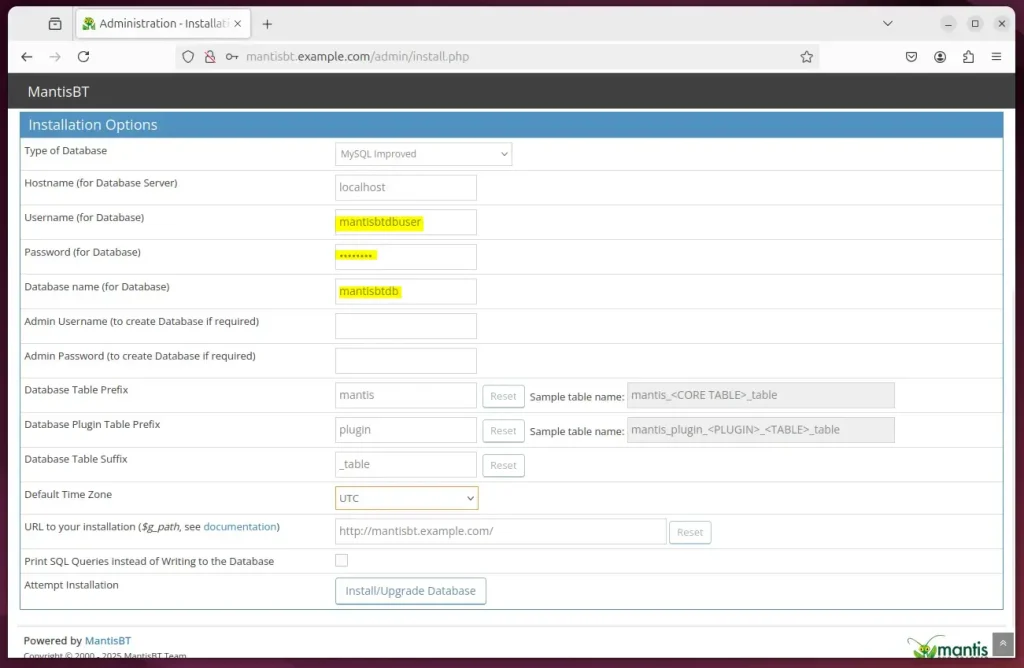
Mantis should be ready to use.
Login with temporary account:
Username: administrator
Password: root
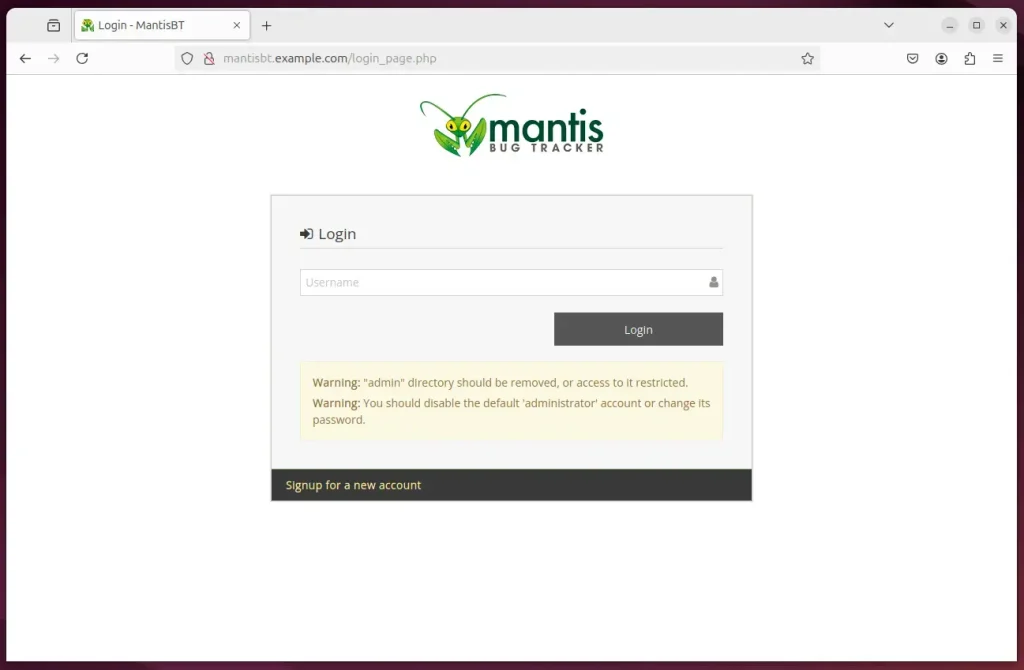
That should do it!
Conclusion:
In conclusion, installing Mantis Bug Tracker on Ubuntu with Apache provides a robust solution for managing bugs and feature requests in software development. Following the outlined steps, you have set up a stable environment that enhances collaboration among team members. Here are the key takeaways:
- Successfully installed Apache as the webserver to host Mantis.
- Deployed MariaDB as the database server to store issues and user data.
- Configured PHP to ensure Mantis runs optimally on your server.
- Downloaded and set up Mantis Bug Tracker files correctly with appropriate permissions.
- Created an Apache virtual host for easier management of your Mantis site.
- Secured your Mantis installation with Let’s Encrypt SSL/TLS for HTTPS access.
- Ready to track and manage bugs efficiently with your new Mantis bug-tracking system?
Completing this installation gives you a powerful tool at your fingertips to streamline your development processes.
What is the alternative to Mantis bug tracker?
Other important factors to consider when researching alternatives to MantisBT include features and user interface. The best overall MantisBT alternative is Jira. Other similar apps like MantisBT are Bugzilla, GitLab, Trac, and Assembla.
Is mantis better than jira?
Workflow Customization: Jira offers a highly customizable workflow feature, allowing users to define and modify their own issue statuses, transitions, and conditions. On the other hand, Mantis has a more limited workflow customization capability, requiring users to rely on predefined workflows.
How to install mantis bug tracker?
Install and Launch Mantis Step 1 − To download Mantis, go to https://www.mantisbt.org/ and click Download. Step 2 − Click Download on the next page as shown in the following screenshot. Step 3 − Again click Download as shown in the following screenshot and save the . zip file.
Was this guide helpful?

About the Author
Richard
Tech Writer, IT Professional
Richard, a writer for Geek Rewind, is a tech enthusiast who loves breaking down complex IT topics into simple, easy-to-understand ideas. With years of hands-on experience in system administration and enterprise IT operations, he’s developed a knack for offering practical tips and solutions. Richard aims to make technology more accessible and actionable. He's deeply committed to the Geek Rewind community, always ready to answer questions and engage in discussions.


No comments yet — be the first to share your thoughts!