How to Refresh Wi-Fi Networks in Windows 11

Refreshing Wi-Fi networks in Windows 11 forces your computer to update its connection list and display nearby wireless signals that fail to appear automatically. This quick scan solves common connection drops and missing network issues across Windows 11 version 23H2 and 22H2 releases without requiring a full system restart. The steps are the same on Home and Pro.
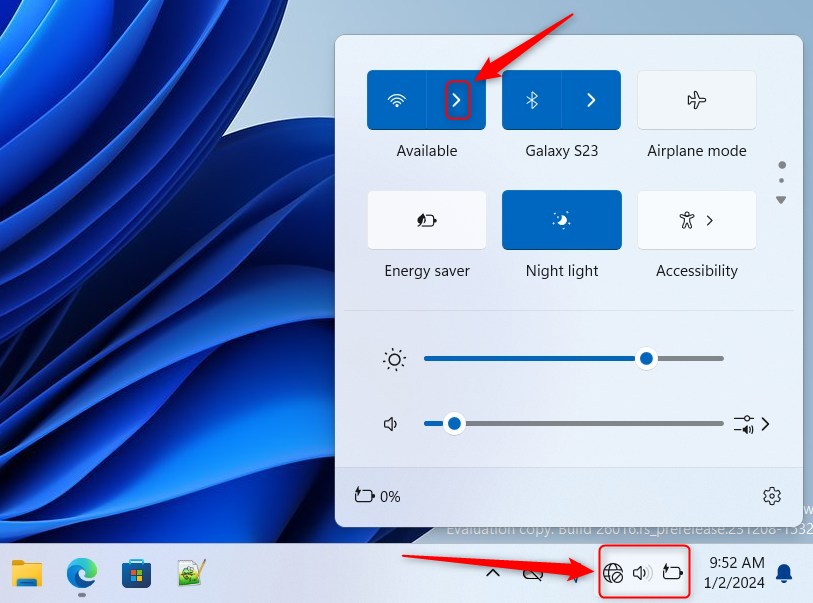
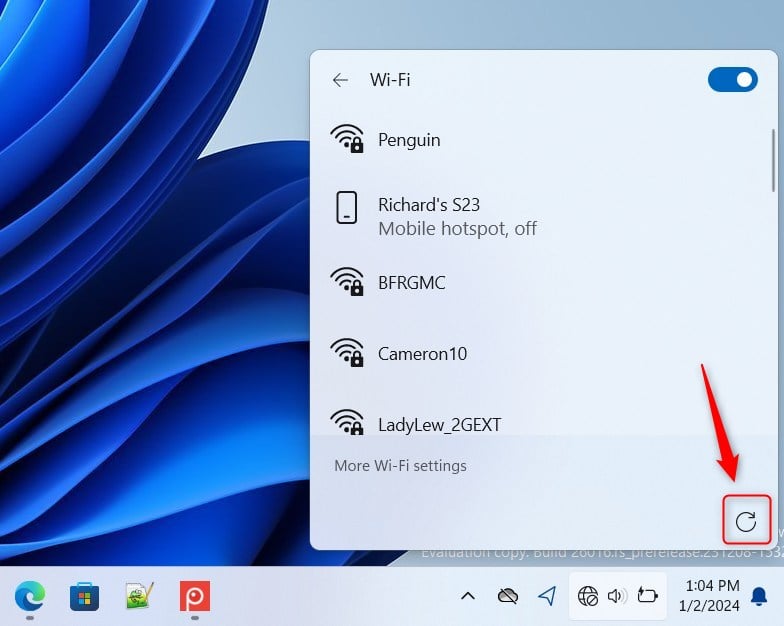
Press Win+A to open Quick Settings, click the arrow next to the Wi-Fi icon, and then click the Refresh button. This forces Windows 11 to rescan for available Wi-Fi networks.
Why Refresh Your Wi-Fi Networks?
Dead signals or glitchy software often hide available networks. The list Windows shows can go stale, especially after sleep, after waking from hibernation, or when you move between rooms.
Forcing a fresh scan, or clearing out a bad saved profile, makes the machine hunt for signals again and brings missing SSIDs back into view. Start with the lightest fix (Quick Settings) and only move to the heavier ones if it doesn’t help.
Quick Fix Table: Wi-Fi Troubleshooting
| Problem | Quick Fix |
|---|---|
| Network not in list | Use the Refresh button in Quick Settings |
| Connection drops | Forget and re-add the network |
| No Wi-Fi adapter | Check Device Manager for driver issues |
| Total network failure | Use the Network Reset feature |
Method 1Use the Quick Settings Refresh Button
This is the fastest method. It asks the Wi-Fi adapter to scan for nearby routers again and redraws the list, and it takes a few seconds.
- Press Win+A to open Quick Settings. A panel with tiles for Wi-Fi , Bluetooth and Airplane mode appears above the taskbar .
- Click the arrow (>) next to the Wi-Fi icon. The list of available networks opens.
- Click the Refresh button at the top of the list. The list clears briefly and then fills with the networks currently in range.
If you don’t see a Refresh button on your build, close the panel and open the list again, or switch the Wi-Fi tile off and back on. Either one makes Windows scan again. If the Wi-Fi tile is missing altogether, check that Airplane mode is off and that the adapter is enabled.
Method 2Forget and Re-add Your Network
If one network keeps failing while others work, the saved profile for it may be corrupted or may hold an old password. Forgetting the network deletes that profile so Windows treats the router as brand new. Make sure you have the Wi-Fi password before you start. You will need to type it again.
- Open Settings Network & internet Wi-Fi
- Click Manage known networks. A list of every saved network appears.
- Find your network and click Forget. The network disappears from the saved list.
- Go back to your Wi-Fi list, select the network and click Connect.
- Enter the password when prompted. Windows builds a new profile and connects.
To undo this, just reconnect and enter the password again. Nothing else on the system is affected.
Method 3Reset the Network Stack via Terminal
If a refresh and a forgotten profile don’t help, the network stack itself may be damaged. The commands below reset the Windows networking components, such as the TCP/IP settings and the Winsock catalog, and clear cached network data. Run them only after the lighter fixes have failed.
- Right-click the Start button and select Terminal (Admin).
- Click Yes if the User Account Control prompt appears. A Terminal window opens with administrator rights.
- Type the following commands one by one, pressing Enter after each, and wait for each one to finish before you type the next:
Type the following commands one by one, pressing Enter after each: This action fixes most deep connectivity issues.
When the last command finishes, restart the computer. Some of these resets only take full effect after a reboot. Your connection may drop while the commands run, which is normal.
Method 4Use the Network Troubleshooter
Windows includes a built-in diagnostic tool that checks the adapter, the router connection and common settings, and applies fixes automatically where it can.
- Open Settings System Troubleshoot Other troubleshooters
- Find the official Windows Network Troubleshooter in the list.
- Click Run and follow the prompts. Pick the adapter or connection you’re having trouble with if Windows asks.
The tool reports what it found, even if it couldn’t fix it. Note any message it gives you, since it helps with the later steps.
Method 5Check Device Manager for Driver Issues
Broken or outdated drivers frequently cause missing Wi-Fi adapters, or Wi-Fi that disappears after an update.
- Right-click the Start button and select Device Manager.
- Expand Network adapters. Your wireless adapter is usually named with “Wi-Fi ” or “Wireless” in it.
- If you see a yellow triangle, right-click the adapter and select Update driver.
- Choose Search automatically for drivers and follow the prompts. Restart if Windows asks you to.
If Windows says the best driver is already installed, check your PC or adapter maker’s support site for a newer one. If the adapter isn’t listed at all, click Action Scan for hardware changes in Device Manager.
Method 6The Network Reset Feature
Unresolved errors may need a master reset. Treat this as the last resort, because it changes more than the Wi-Fi settings.
Before you start, make sure you have your Wi-Fi password. Saved networks are removed, and VPN clients or virtual switches may need to be set up again.
- Go to Settings Network & internet Advanced network settings
- Click Network reset.
- Click Reset now, then click Yes to confirm.
Windows warns you that it will restart in about five minutes. Save your work first. After the restart, reconnect to your network and enter the password. The reset can't be undone, but you can reinstall any VPN software you removed.
Summary
Resolving Wi-Fi connection issues in Windows 11 begins with updating network lists through Quick Settings. If that fails, forget the network and reconnect, then try the troubleshooter and a driver update. Terminal commands or Network Reset handle deeper architectural failures.
Have a question about this guide?
Answered by AI from this guide. Good questions may be added to this page — please don't include personal details.
Did this guide fix your problem?

About the Author
Richard
Tech Writer, IT Professional
Richard is a writer at Geek Rewind who turns complex IT tasks into clear, step-by-step guides. He draws on years of hands-on experience in system administration and enterprise IT operations, focusing on Windows, Linux and WordPress: the problems people actually run into, and the fixes that work. His server and WordPress guides come from systems he runs himself. Richard builds and maintains the platform behind Geek Rewind, from its Ubuntu servers and Nginx configuration to its custom WordPress plugins. Many new tutorials start with readers' questions, and he's always glad to answer them in the comments.
No comments yet — be the first to share your thoughts!